Archives
Tag Cloud
Abandonment Abomination of Desolation Abortion Abraham’s Bosom Abuse Acceptance Accounting Accusation Activism Adoption Adornment Adultery Adversary Adversity Affection Affliction Afterlife Allegory Alliances Altar Ambition America Analogy Angel of the Lord Angels Anger Animals Anointed One Anointing Antichrist Anxiety Apologetics Apostasy Apostle Apostles Approval Armor Armor of God Arrest Ascension Asceticism Ashamed Assembly Assurance Atonement Attitudes Authorities Authority Baal Babylon Bad Baptism Battle Behavior Belief Believer Believers Benefits Benevolence Bethlehem Betrayal Bible Bitterness Blameless Blasphemy Blessed Blessing Blessings Blindness Boasting Body of Christ Boldness Bondage Book of Life Borders Born Again Borrowing Bottomless Pit Bride Bride of Christ Bridegroom Brokenness Brother Built Up Burden Caesar Calling Capital Punishment Care Cares Carnal Cast Away Casting Lots Caution Celebration Chaos Character Charity Chaste Childbirth Children Children of God Choice Choices Chosen Christ Christian Christian Life Christianity Christians Christmas Church Circumcision Circumstances Citizenship Civil Disobedience Clay Cleansing Comfort Commands Commitment Commune Communion Community Comparison Compassion Complacency Complaining Complementarianism Conception Condemnation Conduct Confession Confidence Conflict Conform Conforming Conformity Confrontation Confusion Connect Connection Conscience Consecration Consequences Contempt Contention Contentment Contrition Conversion Conviction Cornerstone Correction Cost Counsel Courage Covenant Coveting Creation Creator Crisis Cross Crowd Crowds Crown of Life Crowns Crucifixion Crucify Cults Culture Curse Danger Darkness David Davidic Covenant Day of the Lord Day of Visitation Deacons Deaf Death Deceit Deception Decisions Defense Defilement Deity Delegation Delight Deliverance Delusion Demon Demon Possession Demons Denial Dependency Design Desire Desolation Desperation Destruction Devil Devotion Devotions Diaspora Diligence Direction Disaster Discernment Disciple Disciples Discipleship Discipline Discontentment Discouragement Disease Disgrace Dishonesty Disputes Dissension Distraction Diversity Divine Divine Appointment Divine Nature Divinity Division Divorce Doctrine Dominion Donation Double Fulfillment Doubt Drought Drugs Duties Duty Earth Earthly Earthquakes Easter Edification Edom Education Egalitarianism Elders Elect Election Elijah Elohim Emmaus Emotion Emotions Employment Encouragement End Times Endurance Enemies Enemy Enoch Environment Environmentalism Envy Equality Equipped Error Established Esteem Eternal Eternal Life Eternity Evangelism Evangelist Everlasting Life Evil Evil Spirits Evolution Exaltation Exalted Example Exclusion Excuses Exorcism Expectations Exploitation Eyes Failure Fairness Faith Faithful Faithful Servant Faithfulness Fall Fall Away False Christ False Christs False Conversion False Doctrine False Gods False Prophet False Prophets False Religion False Religions False Teacher False Teachers False Teaching False-Humility Family Famine Fasting Father Father God Father’s Day Fathers Favor Favoritism Fear Fear of God Fear of the Lord Feasts Feasts of the Lord Fellowship Female Fervor Fig Tree Fights Finances Fire First Coming First Resurrection Firstborn Flattery Flesh Flock Flock of God Folly Food Foods Foolish Foolishness Foreigner Foreknowledge Foreknown Forgiveness Fornication Forsaken Foundation Free Will Freedom Friends Friendship Fruit Fruit of the Spirit Fruitful Fruitfulness Fulfillment Function Futility Future Gehenna Generosity Gentile Gentiles Gentle Gentleness George Wood Giants Gifts Giving Globalism Glorified Body Glory God God the Father God’s Will God’s Word Godhood Godliness Godly God's Will Golden Rule Good Good News Good Shepherd Good Works Goodness Gospel Gospels Government Grace Gracious Gratitude Grave Great Commission Greatness Greed Grief Grow Growth Guilt Hades Hardship Harvest Hate Hatred Headship Healing Heart Heaven Heavenly Heavenly Father Hedonism Hell Help Heresy Herod Hesitation Hidden High Priest Holiness Holy Holy Spirit Home Homosexuality Honesty Honor Hope Hopelessness Hospitality Hostility House of God Human Frailty Humanism humanity Humility Husband Husbands Hypocrisy Hypocrite Hypocrites Identity Idolatry Ignorance Image Image of God Immanuel Immigration Immortal Immortality Impossibility Incarnation Independence Day Individuals Indulgences Indwelling Infilling Inheritance Injustice Inner Battle Innocence Inspiration Instruction Instructions Insults Integrity Intercession Intermediate State Interpretation Intervention Intoxication Israel Jerusalem Jesus Jewish Temple Jews John the Baptist Joy Judas Judge Judging Judgment Judgment Day Judgments Justice Justification Justify Key Keys Kids Kindness King Kingdom Kingdom of God Kingdom of Heaven Kinsman Knowledge Labor Lake of Fire Lamb of God Lamp Last Days Law Law of Moses Law of the Lord Lawlessness Lawsuits Leader Leaders Leadership Leading Leftism Legal Legalism Leprosy Liberty Lies Life Life-Span Light Light of the World Like-minded Listening Living Stone Lonely Lord Lost Love Lovingkindness Lowly Loyalty Lust Lusts Luxury Lying Magdalene Magic Malachi Male Manipulation Marriage Martyr Martyrdom Martyrs Mary Master Masters Materialism Maturity Meditation Meekness Men Mentoring Mercy Messiah Metaphor Metaphors Millennium Mind Mind of Christ Minister Ministry Miracle Miracles Mission Missionary Missions Mocker Mocking Money Morality Mortal Mortality Mother Mother’s Day Mothers Mother's Day Motivation Mt. Sinai Murder Mystery Nations Natural Natural Gifts Naturalism Nature Nazareth Near-Far Fulfillment Necessities Neglect Negligence New Birth New Covenant New Creation New Earth New Heavens New Jerusalem New Man New Self New Testament Oaths Obedience Obstacles Obstructions Offense Offenses Offering Old Covenant Old Man Old Nature Old Self Old Testament Omnipotence Omnipresence Omniscience One Mind Opportunity Order Orderly Others Outcast Outer Darkness Overseer Overseers Oversight Pagan Pain Palm Sunday Parable Parables Paradise Paranormal Pardon Parenting Passion Passover Path Patience Patriotism Peace Peer Pressure Pentecost People of God Perception Perfect Perfection Persecution Perseverance Persistence Personal Injury Personal Testimonies Perspective Persuasion Perversion Perversity Pestilence Peter Petition Pharisees Philosophy Piety Pilate Pilgrim Plan Plans Pleasure Politics Poor Pornography Position Possession Possessions Posture Power Praise Prayer Preach Preaching Preparation Preparedness Presence Preservation Pretense Pride Priesthood Principles Priority Prison Privilege Prodigal Profane Profession Promise Proof Prophecy Prophet Prophets Prosperity Protection Protestant Protestant Reformation Proverbs Providence Provision Pruning Punishment Purgatory Purification Purity Purpose Purposes Questions Racism Raised Ransom Rapture Readiness Reason Rebellion Rebuke Receiving Reconciliation Redeemer Redemption Refuge Regeneration Rejection Rejoice Rejoicing Relationship Relationships Relativism Reliability Religion Remember Remnant Renewal Repentance Reputation Rescue Resolve Respect Rest Restoration Resurrection Retribution Revelation Revenge Revival Reward Rich Riches Ridicule Righteous Righteousness Rights Riot Risk Ritual Rivalry Robbery Roman Catholic Roman Catholic Church Rome Rooted Rule Rulers Rumor Sabbath Sacred Sacrifice Saint Saints Salvation Sanctification Sanctuary Sarcasm Satan Satisfaction Savior Schemes Science Scoffer Scoffers Scripture Seal Seasons Second Coming Second Death Secret Sedition Seed Seek Self Self Control Self-centered Self-Control Self-Denial Selfish Ambition Self-Preservation Self-Righteous Servant Servant-Leadership Servants Serve Service Serving Sexual Immorality Sexual Sin Sexuality Shame Share Sharing She’ol Shepherd Shepherds Sickness Signs Signs and Wonders Silence Simplicity Sin Sincerity Sinful Nature Singing Singleness Sinner Sinners Skepticism Slander Slave Slavery Slaves Sober Sobriety Socialism Society Sojourner Sojourners Son Son of God Son of Man Sons of God Sorcery Sorrow Soul Source Sovereignty Speaking in Tongues Speech Spirit Spirit Baptism Spirit Beings Spirit Realm Spirit-Led Spirits Spiritual Spiritual Adultery Spiritual Battle Spiritual Birth Spiritual Condition Spiritual Death Spiritual Gifts Spiritual Growth Spiritual Maturity Spiritual Powers Spiritual Rulers Spiritual Warfare Steadfast Stewardship Storms Stranger Strength Stress Strife Strong Struggle Stumble Stumbling Block Subjection Submission Substitution Suffering Suicide Supernatural Supper Supremacy Surrender Survival Swear Symbols Syncretism Tabernacle Tags: Patience Taxes Teacher Teachers Teaching Teachings Tears Technology Temple Temptation Temptations Tenderness Terminal Illness Test Testify Testimony Testing Tests Textual Issues Thankfulness Thanksgiving The Beast The Curse The Day The Day of The Lord The End The Faith The Fall The Flood The Gospel The Grave The Great Tribulation The Holy Spirit The Lamb of God The Law The Law of Moses The Mind of Christ The Restrainer The Secret Place The Way The Word The World Theft Theology Thought Life Threats Throne Time Time of Visitation Times of the Gentiles Timing Tithing Tongues Tower of Babel Tradition Tragedies Tragedy Training Transfiguration Transformation Traps Treachery Treasure Tree Tree of Life Trial Trials Tribulation Trifles Trinity Triumphal Triumphal Entry Trouble Trust Trustworthy Truth Tyranny Unbelief Unbelievers Uncertainty Underground Church Understanding Unfaithfulness Ungrateful Uniformitarianism Unity Unpardonable Sin USA Utopia Value Vanity Vengeance Victory Vigilance Vindication Virtue Virtues Vision Visions Visiting Ministries Voice of God Volunteer Volunteers Vow Vows War Warfare Warning Warnings Wars Watch Watching Water Baptism Water of Life Weak Weakness Wealth Weary Wicked Wicked Plans Wickedness Widows Wife Will Wineskins Wisdom Witness Witnesses Witnessing Wives Women Wonders Word Word of God Word of Knowledge Word of the Lord Work Works World World View Worry Worship Worth Worthy Wounds Wrath Wrath of God Yahweh Yeast YHWH Yoke Zion

Weekly Word

Entries in Prophecy (50)

Sunday
Apr052020

Who Is My Savior?

Mark 11:1-11.  This sermon was preached by Pastor Marty Bonner on Palm Sunday, April 5, 2020.

This week, we are approaching the Passover celebration.  On this day, we celebrate what is typically called The Triumphal Entry.  One way of looking at this day is that we are celebrating this event as it should have been.  Jesus should have been received as the Messiah by his people.  This should have ushered in a time of peace in the world.  Instead, he was rejected and the world entered into a time that the Bible calls, “The Beginning of Sorrows,” and also, “The Birth Pains.”  Here, almost 2,000 years later, those pains are only increasing in intensity.

It is generally clear that mankind needs saving from its sins, though not all will use those words.  However, less clear to each of us is God’s contention in the Bible that all individuals are in need of saving, none excluded.  Christ came in such a way as to put the solution in front of each of us.  On that Sunday so many years ago, Jesus put the question before Israel as a whole, and yet also before each Israelite.  Who is my savior?  What is my choice?  Let’s look at our passage and work through these things.

The preparations of the Savior (vs. 1-6)

Our story opens with the arrival of Jesus in the Jerusalem district for his last time.  Within a week, he will be crucified on the cross.  He stops at this point to make some final preparations in order to enter the city.

However, we should take note that the previous 3 ½ years of the ministry of Jesus was all about preparing Israel for this day of choice.  Every miracle and every amazing teaching had been about preparing the hearts of Israel for a day of decision.  I don’t just mean the 24-hour period we call the Triumphal Entry.  I mean the whole week. 

Israel was being tested and they didn’t know it.  Most of them loved the idea of a Savior, a Messiah, but they did not love the idea of what Christ came to do.  He came to offer himself as a sacrificial lamb to deal with our sins, when they wanted a ferocious warrior to deal with their enemies.  Does that sound familiar?  Isn’t there a part in all of us that would rather have our enemies crushed than to expose and deal with our sins?  This is what this is all about.  It is about a choice that I must make regarding what I think can save me, or fix my life and my future.

Thus, it is important what we choose in the moment, but all momentary decisions will be tested.  You can make the right decision when it is easy, but your resolve to do the right thing will be tested.  Israel went from seemingly choosing Jesus to rejecting him in less than a week.  Their choice of Jesus was not nearly as strong as it may appear in our story today.  Ultimately, we are pulled away from faith in Jesus by the ways of this world, its power and prestige, its money and technology.  When you are fearful that the way of Jesus may not save you anymore, these are the things you will flail about and grasp tightly.  Yes, God had made great preparations leading up to that moment, just as He has made great preparations leading up to the moment that you were presented with the Gospel.  Yes, embrace Jesus, but also know that your embrace of him is going to be tested.

When Jesus stops near the Mt. of Olives, there are two villages that he stops at.  Their names are quite symbolic.  Bethphage means “House of green figs,” and Bethany means “House of my sorrow.”  Jesus had come to Israel expecting ripe fruit, but it was still green, inedible.  He came to those who were his own and should have embraced him with open arms, but they became to him a house of sorrow.  These things give more light on the whole incident following our passage today where Jesus curses a fig tree that had no ripe figs.  More on that at a different time.

The last preparation involves sending a couple of disciples out to secure a donkey’s colt.  From Matthew 21:7, we know that both the colt and the mother are involved.  Some details are left out or missing in Marks account, but it appears they were left out for the disciples too.  Jesus is not advocating stealing here.  Rather, he is telling them to get something and when they do exactly what he says, it goes exactly as he said it would.  A truism of life is that God often has us do things that do not make sense to us, like love our enemies, and forgive those who harm us.  However, he knows what he is doing.  He is preparing us to do what he has for us.  In these times, the lack of details regarding the benefit to these things often causes us to balk.  Yet, if we simply obey, we will eventually find that our Lord had everything figured out ahead of time, and we simply needed to trust his directions.  Whoever this owner is, he is willing to let the Lord borrow his donkeys, and Jesus knew that he would.  Now that the preparations have been made, Jesus is ready to head into Jerusalem.

The presentation of the Savior (vs. 7-10)

Up to this point, Jesus has resisted any attempt to present himself formally as a potential king for Israel.  However, on this day, he not only allows it, but he orchestrates it.  He is now forcing the issue and the question within Israel about the question of his identity.  Is he the Messiah or not?  This is a presentation event in which Jesus clearly presents himself to Israel; let me be your savior.

He purposefully sets up the imagery as one of a lowly person (humble) coming in peace.  He rides down the hillside of the Mt. of Olives, crosses the Kidron valley, and then up into the city on a donkey’s colt.  It is Matthew who connects this event to the prophecy in Zechariah 9:9. There it is said, “Rejoice greatly, O daughter of Zion!  Shout, O daughter of Jerusalem!  Behold your King is coming to you; he is just and having salvation, lowly and riding on a donkey, a colt, a foal of a donkey.”  Apparently, they didn’t make the connection when it was happening.  They just knew that Jesus was finally doing something that looked like he was ready to take control.  They are ready for the Kingdom of God to begin.

Now, the riding of a donkey is in contrast to riding on a horse.  A horse has connotations of war, power, and prestige, whereas a donkey has connotations of humility and peacefulness.  Zechariah had revealed to Israel that, when the Savior came, he would come in such a way.  When we contrast this image with the one of Jesus coming on the clouds of heaven and riding a white horse in Revelation 19, the message is clear.  He was not here for war all those years ago.  He had come to do a far dirtier job than Mike Rowe could ever conceive.  It would be like a boxing match where they are introducing the boxers.  “In this corner, we have…” (someone who does not look like they will win).  Though many of Israel were excited on that day, it is clear that Jesus is still a mystery to them.  What kind of Savior was he?

Let’s look at the crowds and their praise of Jesus.  There are two dynamics going on in this crowd.  In Mark, it only focuses on the disciples of Jesus (more than just the 12) excitedly running ahead of him, around him, and behind him.  They are rejoicing as Zechariah said they should, but for uninformed reasons.  They believe he is here to kick out the Romans, wicked priests, and Herod.  They think he is going to set all things right in society.  The second dynamic is that word had gone ahead into the city, and so, crowds were coming out from Jerusalem to meet him.  Among these crowds, there were some religious Pharisees who did not think Jesus was the Messiah at all.

In Luke 19:39, we are told that the Pharisees objected to the things that the disciples were hollering about Jesus.  They shout to Jesus that he should make them shut-up.  Jesus is very humble, but there comes a time when some things must be done.  Jesus had to present himself to Israel as a potential savior because it was the Father’s will.  It was the reason he had come.  Israel had to have a choice.  Thus, Jesus rebukes the Pharisees who are trying to rebuke him.  “I tell you that if these should keep silent, the stones would immediately cry out.”

The crowds can be right, but the crowds can also be wrong.  They are easily driven to shout with praise on one day and then shout with anger on another.  The point is not what the people around you are doing.  The point is always, what does God want me to do?  Just as God was presenting His Son Jesus to Israel during the week leading up to Passover, so He presents Jesus to us today.  He doesn’t look like we think that he should, and some people may be shouting his praises for all the wrong reasons.  The main point is what does God want you to do with Jesus.  He wants you to embrace him in faith, and rejoice in the fact that he has come to save you!

The phrases that these disciples are shouting out, are chosen purposefully.  They come from Psalm 118 and were understood by all to be referring to the Messiah.  Psalm 118:25 gives us the Hebrew phrase translated “Cause us to be saved, now!”  The Greek transliteration is Hosanna!  What a cry, that not only was on the lips of Israel that day, but is on the minds of people all across this world, today.  We want someone to rise up and save us from our problems and the problems of this world.

The second thing they are shouting comes from Psalm 118:26, “Blessed is he who comes in the name of the Lord!”  They are using biblical words from the prophecy that predicts his coming in order to praise him.  Oh Church, may we learn to take time just to stop and praise the Lord Jesus for what he has done and what he will do!  Sometimes we don’t know what words to use, but the Bible supplies us with many wonderful ways of praising the Lord Jesus.

The disciples and the crowds believe that Jesus has been sent from the Father and they are asking him to start saving them.  Some of these cries mention the kingdom of David.  In other words, they are ready for the Romans to be expelled and the Kingdom of David to be restored to the full promises that God gave to him.  Let’s look at verse 11 and bring this to a close.

The investigation of the Savior (vs. 11)

It may not have been quite so clear that day, but Jesus then takes time to investigate this place that is crying out for his salvation, both the city and its place of worship.  It is at this point that we sometimes forget that when we are making an investigation of Jesus as to his worthiness as a Savior, he also is making an investigation of us as to our worthiness as a disciple.

Luke 19:41-42 tells us that Jesus weeps as he approaches the city, but they are not tears of happiness.  He says, “If you had known, even you, especially in this your day, the things that make for your peace!  But now they are hidden from your eyes.”  We may not realize it, but there are things that would make for our peace, whether in America, or in our individual lives, but we have to have the wisdom to choose them.  Be careful that you are not manipulated into rashly supporting things that actually make for your own harm, or the harm of our nation.  Jesus goes on to use another phrase in Luke 19.  This was their “day of visitation,” not of a friend wanting to chat, but of our Lord coming to inspect.

Israel had waited for the Messiah to come for so long, and now he was here, but he had come to make an inspection, and they weren’t ready.  Always remember that choice is a saw that cuts both ways.  Jesus has presented himself to you to investigate and to choose, or not to choose, as your savior.  Yet, at the same time, he is investigating you.  What is really going on in that heart of yours?  You say you want righteousness and salvation, but what do you really want?  What will you really choose when put to the test?  They were not ready for their surprise inspection that day, and I dare say that the United States of America is not ready today if Jesus were to come and investigate us.  Friend, you had better make sure that you are ready to stand before the Lord, before he shows up.  Only repentance and faith in him can save us and bring us into his grace.

Jesus then enters the city and goes into the temple compound.  He simply looks around at everything.  It is fitting that he should not rashly judge the things that he is seeing there.  The next several days will be filled with him coming into the temple area and confronting the things that were wrong with Israel.  It may feel anticlimactic, but the true climax was coming at the end of the week, when he would hang on a cross for them and for us.

The day ends with Jesus simply going back to Bethany to stay the night.  In the morning, he will return to Jerusalem to teach in the Temple area.  He will do this several days in a row.  At the same time, the city will increase with people coming from all around the world for the Passover feast.  This dynamic forces the hands of the religious leaders.  Jesus is being too audacious.  They can’t let this continue, or at least that is what they think.

We can get lost dreaming about what the world would be like if they had simply embraced Jesus as Messiah that week.  It is similar to dreaming about what the world would be like if Adam and Eve hadn’t sinned, or if early American settlers had not used slavery.  We can look backwards and blame all our problems on those who sinned before us in a never ending “if only…”  However, you can’t unspill spilled milk.  You can only ask the Lord to help you clean up the mess and move forward.  Sin is a mess that we can’t clean up on our own, whether as a world or as an individual.  God has put the humble and peaceful Jesus in front of you, and asks you to choose him as your savior.  He doesn’t always lead in the way that we think he should lead, but follow him to the end, we must! 

The day is coming when Jesus will split the skies and return to this earth as a glorious, conquering king.  Whether I am alive on this earth on that day, or not, is immaterial.  I will still be held accountable for my choice.  Choose this day whom you will serve because not choosing Jesus is the same as choosing what this world is offering.  It is offering unending worthless things that eat up your life and leave you empty in the end.  Come to Jesus and let him be your savior today!

Who is my Savior audio

Tuesday
Mar172020

Jesus Foretells His Future a Third Time

Mark 10:32-34.  This sermon was preached by Pastor Marty Bonner on Sunday, March 15, 2020.

I am always a bit leery of using the word “foretell” with Jesus or his prophets because it has connotations that are more associated with fortune tellers and those who try to predict the future.  Jesus, however, was not a skilled fortune teller, nor was he a skilled political analyst who was able to see what would happen in the future.  Rather, Jesus is telling them before hand what will happen in the future because he and the Father have discussed this in heaven.  Jesus had come down as the One and Only Unique Son of God.  It was the plan of God for the things we will discuss today to happen.  This does not mean that God is forcing the wicked players involved to do what they do.  Instead, God incorporates their willful rebellion into His plan.

In Mark’s Gospel, he wants us to be clear that Jesus knew that the events leading up to the crucifixion were coming.  Jesus had taught his disciples that rejection was part of God’s plan.  Though the leaders of Israel would cast Jesus aside, The Father would overrule their decrees.

Let’s look at our passage today.

The last march up to Jerusalem

Mark 10 begins a transition in the book.  It opens in verse 1 telling us that Jesus was in the region of Judea on the other side of the Jordan.  In these verses today, they are on the road to Jerusalem.  At the end of the chapter, they will be in Jericho.  Thus, they are somewhere between the other side of the Jordan and Jericho at this point.

Mark 11 opens with the Triumphal entry, which occurs less than a week before the crucifixion.  This is how close we are in this passage to the death and resurrection of Jesus.

Mark tells us in this passage that the disciples are amazed and that they are afraid.  They are afraid because Jesus is going up to Jerusalem and the religious leaders were trying to get Jesus.  This is interesting because the disciples believe to things that are in tension with one another.  On one hand, they are finding it hard to believe that the Messiah would actually be killed.  Yet, on the other hand, they are definitely afraid of the intentions of the religious leaders.  This is not a contradiction.  The tension is between what they believe should happen, according to the prophecies about the Messiah, and their knowledge that the very powerful leaders are seeking to arrest Jesus and perhaps them.  The Gospels all tell us that Jesus warns his disciples multiple times about his coming death, and many people were warning them that the religious leaders were out to get them.  So, this explains their fear, but what is amazing them?

In contrast to the disciples, we are told that Jesus is leading in front of them.  He is purposefully headed towards Jerusalem and they are amazed at his fearless approach to the city that held so much danger for them.  Jesus is not sneaking under the cover of darkness, nor is he keeping a low profile (at Jericho he heals the blind Bartimaeus).  He is not leading from the back of the group, or from the center as an attempt to protect himself.  Rather, he is leading in front of them, like a true Captain of our salvation.

Of course, I use that terminology because the writer of Hebrews 2:10 gives this image to us.

“For it was fitting for Him, for whom are all things and by whom are all things, in bringing many sons to glory, to make the captain of their salvation perfect through sufferings.”

Jesus was a fearless leader because his relationship with the Father was inseparable and without doubt.  He marches in front of us, even today, but not so much in front that the weak are left behind.  Thus, we see Jesus sensing their fear of what lies ahead, and yet their amazement at his bold march towards certain trouble.  He stops and takes time to speak to them about it.

Sometimes those who lead into difficult times or circumstances are not so noble in their leading.  It is easy to mislead people regarding what lies ahead in order to get compliance or quell panic.  Some may even keep those they lead completely in the dark.  Jesus was not this way.  He is being truthful and honest with the disciples about the difficult things ahead.  Yet, he is taking time to bring them along.  He is modeling for us what it means to carry your cross and follow God’s plan.  No, it is not easy on our flesh, and yes, we must take time to pray and encourage ourselves in what God would have us do despite all of the fearful things that we may see around us.  We also see him modeling how those who are strong in faith should come alongside of those who are not, and encourage them in marching towards the plan of God.

I want to tell you today that Jesus knows your fears about what lies ahead.  By His Holy Spirit, He is marching ahead of you to lead you to the Father, and to perfect that work of God within you.  However, he will stop from time to time in order to draw you near to him and speak the truth to you in love.  Hard times lie ahead, but fear not!  Jesus is with us, even unto the end of the age!  Let us not forget that our Lord has not abandoned us, but that he is marching in front of us.  We can trust his plan because he has proven his heart on the cross.

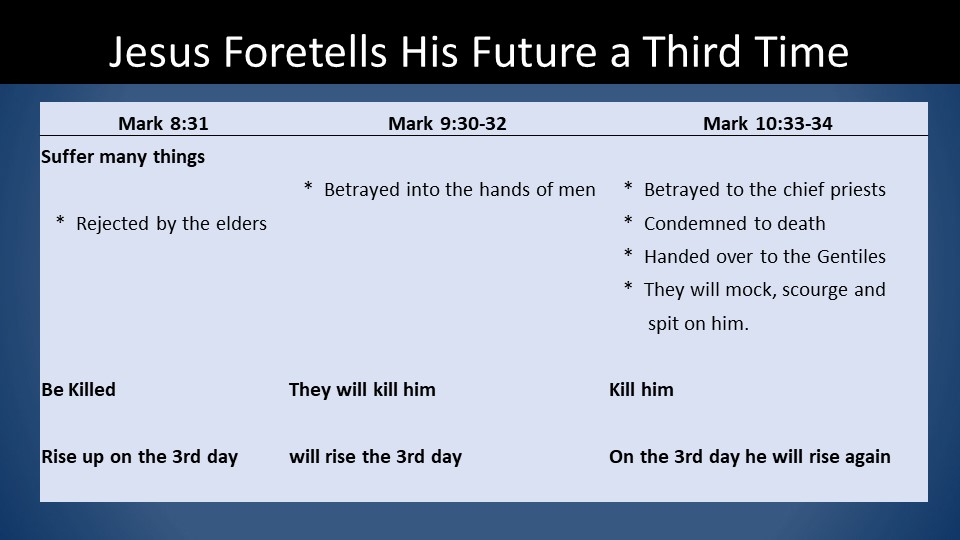
As I said, Jesus doesn’t sugar coat what lies ahead.  This is the third time that Mark describes Jesus telling them about his coming death and resurrection.  More than likely, Jesus had more than these 3 discussions.  Here is a breakout of what Jesus told them in those discussion.

We see that in Mark 8:31 Jesus references 3 main events.  He will suffer many things, which is only detailed by being rejected by the elders.  Then he will be killed, and after that on the third day he will rise again.  We are therefore given a three-stage outline of the events ahead.  His suffering, his death, and his resurrection.  In Mark 9:30-32, the same three stages are outlined, but now we are told that part of his suffering will be in a betrayal.  It is one thing to be rejected by the leaders who never liked you, but betrayal involves someone that is close to you.

In Mark 10:33-34, we again have a reiteration of these three stages with more detail on his sufferings.  He would be betrayed to the chief priests, condemned to death by them, handed over to the Gentiles, mocked, scourged, and spit upon.  This is a pretty detailed list of just how bad things were going to get.  Jesus does not mention what will happen to the disciples here, but they cannot say that he never warned them.

Many Christians around the world today are having to deal with the reality that their future involves many such sufferings, and even the threat of death.  They have to choose whether they are going to follow a Lord that leads them into such difficult and impossible circumstances, or turn back.  We live in a part of the world where it is much easier to follow Jesus.  There are no literal crosses and prison cells directly in our path, but we do see around us a world of chaos that doesn’t know its right hand from its left.

I want to encourage us, but not by sugar coating what lies ahead.  I want to encourage us, but not by freaking out and shouting, “Run for your lives!”  No.  There are many things ahead that you and I will have to suffer.  We don’t exactly know what those things will be for us.  However, Jesus will lead us, and teach us, and give us strength.  He will bring us along until that day that we too breathe our last and leave this earth.  It most likely won’t be on the third day after our death, but we too will rise again.  This is God’s promise to all those who put their trust in Him.  This is our glorious hope.  Do not look to the wisdom of this world to lead us into peace and safety, or to chart a path into a better world.  Yet, do not surrender to fear and desperation.  Our God has a plan through all of this.  He will not abandon us, even though we may face a martyr’s death.  We will rise again, reign with Him, as God fulfills His promise to all those who have waited for Him in trust!  Let’s rise up, follow Jesus, and trust in Him no matter what lies ahead!

Jesus Foretells His Future audio

Wednesday
Oct092019

Views of the End Times: Pretribulationism

Various Passages.  This sermon was preached by Pastor Marty Bonner on October 6, 2019.

Over the last 2 weeks, we have talked about different views regarding when the Rapture of the Church will take place.  Posttribulationism says that the Church is raptured at the end of the Tribulation during the Second Coming of Jesus.  Midtribulationism says that the Rapture of the Church is an event that is separate from the Second Coming of Jesus.  In the middle of the seven-year period called the Tribulation, Christ will resurrect believers who are dead, rapture the living believers, and take them to heaven to await the Second Coming.

Our view today is the only, main view left.  Thus, we will not have a new filtering question today, but will recognize that this view is the only one that answers, “Yes,” to our last question.

Is there a rapture of the Church before the Tribulation?

Pretribulationism, or the Pretribulation Rapture view, believes that the Rapture of the Church will happen before the Tribulation begins.  Some see this as the event that starts the Tribulation and others give a gap between the Rapture and the Tribulation.  We will not get that precise as we look at this view.

Another thing to point out, before we look at this view, is that the previous challenges to the Posttribulation and Midtribulation views have strengthened the position of this view.

Here is the view of Pretribulation Premillennialism regarding the end times.  As we have stated, Christ will rapture his Church before the Tribulation begins.  Some people will come to faith in Christ after the Rapture and during the Tribulation.  These will face martyrdom and must refuse the mark of the beast to the end in order to be saved (this assumes a true, living faith in Jesus).  These are called Tribulation Saints.  In heaven, resurrected believers will be rewarded for their service, and a marriage supper of the Lamb will occur.  Then the glorified Church will return with Christ and his angels in order to remove the usurping powers, and to take control of the kingdoms of the earth.  Those who were faithful in the Tribulation will be allowed to enter Christ’s kingdom.  The Tribulation Saints who were killed will be resurrected at the Second Coming of Christ.  The rest of the view is basic Premillennialism and has been covered in our previous sermons.  Now, let’s look at the arguments used to support this view and any problems with it.

Argument 1.  The removal of the Restrainer in 2 Thessalonians 2:3-7 is in reference to the Holy Spirit working through believers, and He cannot be taken away from believers.  Thus, the Rapture must occur at the same time the Restrainer is removed.  If we look at the passage in question, it is clear that the Apostle Paul is trying to calm down the Thessalonian believers who had been led by some teachers to believe that the Day of Christ had already started.

To be clear, the Day of Christ is synonymous with the Day of the Lord mentioned by practically every prophet of the Old Testament.  The Day of the Lord referred to a time when the Lord would rise up in terrible power to judge the nations of the earth.  It would be a time full of judgments and is basically the Tribulation period that we have been mentioning.  They are afraid that the Tribulation has already begun. 

Yet, Paul is telling them that they are not in the foretold Tribulation, or judgment of the nations, because certain things haven’t happened yet.  The two things that must happen before the Tribulation can begin are: the falling away and the revealing of the man of sin.  It seems clear in the argument that these two things had not happened yet, and so the believers could stop worrying that they were in the Day of Judgment. 

For our purposes, we need to deal with two aspects of the Pretribulation argument.  First, in verse 5, believers are reminded that Paul had taught them these things when he was with them.  How I wish Paul had filled us in on all that he had taught them because he mentions several things without further explanation that would be extremely helpful to our understanding.  He emphasizes that something or someone is restraining the work of lawlessness on the earth.  If it was not restrained then the man of sin, or the Antichrist, would have come forward long ago.  Verse 6 refers to a thing that restrains, but verse 7 changes the grammar and refers to a being who restrains.  The Holy Spirit is uniquely qualified to fit both of these expressions.  He has the power to do so, the word “Spirit” is neuter in Greek and thus can take a neuter participle “the (neuter thing) that is restraining,” and He is a being and thus can be referenced with the personal form “the (being) that is restraining.  I know that this is a language mechanics issue that can easily cause our eyes to gloss over, but it is important.  The main point is that the most likely candidate for being a thing and yet a being who restrains the Antichrist from being revealed is the Holy Spirit.

Now that we have identified the Restrainer, the argument moves to verse 7 where we are told that the Restrainer is taken out of the way.  The Holy Spirit must be removed, and yet cannot be taken from believers.  Ergo, both will be taken together (the Rapture).  There is one problem with this logic.  It doesn’t actually say that the Holy Spirit is “taken” out of the way, or that He is removed from the earth as some say.  It literally says that He will restrain until “He becomes out of the middle of the way.”  Of course, this is not good English and requires some translation polish.  The Holy Spirit is not “taken.”  Rather, He comes to be out of the middle of the way.  He isn’t taken from the earth.  Rather, He is not standing in the middle of the way of Satan’s final plan.  This does beg the question.  If Christians are left on the earth full of the Holy Spirit, wouldn’t they still be a restraint to this guy coming forward?  The response would be that God gives him authority to have power over Christians for a short season.

The second issue with this passage has to do with verse three.  Some in the Pretribulation view have taken the word “falling away” and challenged its meaning.  The Greek word is apostasia.  All other uses of this word in the Bible refer to a defection from faith in God.  However, its main meaning is “to move away from an established place.”  Some have tried to make this about Christians moving away from the earth (the place that we have been established).  This argument has a technical genius to it that smacks of creativity more than it smacks of truth.  Either Paul used this expression as a kind of tongue-in-cheek statement, or he is simply saying that there will be a falling away from the true faith of God in the end times.  Both interpretations would fit the passage well.  However, the most natural understanding of the phrase is a defection from the faith.

So, where does this leave us?  I still think the Pretribulation view gives the best understanding of this passage, but it is not without its questions.  Are we missing something in Paul’s shorthand account that would could critically change how we view the passage?  It seems likely, but it is just as possible that that information would tilt this passage towards the Pretribulation view.  Paul didn’t want them freaking out that they were in the day of judgment.  The Holy Spirit being “out of the way” doesn’t require the Rapture, but it doesn’t preclude it either.  In this age, the work of the Holy Spirit is hand and glove with true believers, and it is possible that the Rapture would be an event in which the restraint of this world’s wickedness would be removed.  The main problem is that Paul didn’t give us all the answers that he could have due to the fact that he had already told the Thessalonians these things.

Argument 2.  The Philadelphian Church in Revelation 3:10 symbolically represents the faithful Church in the end times.  Christ promises to keep them out of the hour of trial that will come upon the whole earth.

Here, Jesus gives the Philadelphians of Asia Minor (Turkey today) the promise that they will be kept out of the hour of trial that will come upon the whole world.  He doesn’t explain how they will be kept out of it.  Will it happen during their time, but not touch them?  Or, will Christ remove them before the hour of trial begins?  Last week we mentioned two critical points about this passage.  One, the word “from” is better translated as “out of the trial.”  Second, there is a definite article with trial “the trial.”  This means that this is a very specific trial that they know is coming.  A particular trial that would come upon all the world is something that believers have known about throughout the Old and New Testament periods.  Some people try to limit this trial to the 2nd century AD by saying it refers to the whole Roman world, but this is an artificial limiting.  The word refers to the inhabited areas of the earth, which went far beyond the Roman boundaries.  So, is it more likely that Jesus is referencing the Great Tribulation?  It is very possible since we are at a loss to find a time of trial that came upon the whole inhabited earth.

It is common among this view to see the Seven Churches of Revelation chapters two and three as being typical or symbolic of 7 Stages of the Church Age.  We don’t have time to look into the arguments of this view.  It has a certain charm because the descriptions do follow a similar path as the history of the Church.  Also, there are a few clues in the text that hint at something more going on here than just a message to seven first century churches.  The word “mystery” is used of these churches, and they represent the “things that are,” which can be extended to mean the whole Church Age. 

This view would see the sixth Philadelphian Church as the sixth phase of Christianity.  There would be a rise of faithfulness to the truth of Christ.  However, at some point the Laodicean type Church would take the ascendency within Christianity.  The last phase involves both Philadelphian believers holding on to the truth and a large group of Laodicean "believers" who are useless to Christ.  This can also give rise to the idea that only strong Christians will be raptured and the carnal Christians will be left behind.  Regardless, contextually it is not completely clear that the Seven Churches are seven phases of the history of the Church.  However, it is possible.  Also, the Great Tribulation is the best fit for interpreting “the hour of trial,” mentioned here.

Argument 3.  Christians are promised to be delivered from the wrath to come and thus must be removed before the Tribulation.  This is the same argument that we saw last week with the Midtribulation view.  It is a powerful argument that can be seen in 1 Thessalonians.  1 Thessalonians 1:10 mentions that Jesus delivers us from the wrath to come, and 1 Thessalonians 5:9 says that God did not appoint believers to wrath, but to obtain salvation.

The main objection to this argument is that these are referring to the wrath of the Lake of Fire, not the wrath of God during the Tribulation.  This is possible and the passages can be read either way.  Yet, most references to the wrath of God refer to events here on earth, and the wrath of the Tribulation is what believers would have directly in front of them more than the Lake of Fire.  Sure, we can die any day and thus the Lake of Fire is closer to us than the Tribulation.  However, in regards to God delivering the Church from the Wrath that He is going to pour out, the Tribulation is the more natural reference than the future judgment at the Great White Throne Judgment (Revelation 20).  So, I rate this as a fairly strong argument.

Argument 4.  The promise of Jesus in John 14 parallels the Bride and Bridegroom imagery.  In John 14:1-4, we have Jesus telling his disciples that he is going away to his Father in order to prepare a place for them.  He then says that, if he goes away to prepare a place for them, he will doubtless come again to receive them to himself (literally to receive alongside oneself).  It pictures him coming to be reunited with them.  From that point, his disciples will no longer be separated from him.  Where he is, they will be.  The natural emphasis of this passage is that Jesus prepares a place in heaven, then comes back for his disciples, and then takes them to the place he prepared.

This is most likely an allusion to the Hebrew wedding practices of the day.  A bride would be betrothed to a husband.  He would then go and make a place for them within his father’s estate.  When he is finished, he would come to pick up his bride and take her to the place that he has prepared.  There would be a marriage supper, or feast, to celebrate the couple’s union. 

This gives better light to Revelation 19.  In that chapter, we are told that the wife of the Lamb has made herself ready, and then a blessing is declared.  “Blessed are those who are called to the marriage supper of the Lamb!”  The next scene is Christ coming with his saints and angels to destroy the beast, false prophet, and the kings of the earth and their armies.  Revelation doesn’t explicitly state that the marriage supper of the lamb happens in heaven before the Second Coming, but in view of John 14, this seems to be the most likely explanation.  John is writing to people who would totally understand the things being mentioned.  This is another strong argument to me.

Argument 5.  It makes the most sense of the passages that portray the coming of Christ as imminent.  I won’t go through all the verses.  However, many verses speak of Christ’s coming as being near, or at hand.  Only the Pretribulation view satisfies the idea that Christ could come at any moment.  All the other views have a number of years in which obvious prophesied events are happening. 

Typically, people who reject this argument do so by stating that the disciples and Jesus were simply wrong.  They thought it was near, but it was really quite far away.  Of course, then we would have a problem with the trustworthiness of the teachings of Jesus.  He is either the Word of God, and is therefore not wrong, or he is not trustworthy even in matters of salvation.  You can’t have it both ways.  I choose to trust Jesus, and to believe that the passages are intended to keep every generation on their toes.  Yes, God knew that the coming of Christ would be at least 1,900 years away, but that generation would need to know that he could come at any moment.  Such a promise, or warning, helps believers of every age to live a life that is ready for Christ at all times.  So, I find this to be a strong argument as well.

Argument 6.  The righteous being rescued before judgment is a common theme in Scripture.  However, the only safe place during the Tribulation will be in heaven itself.

This is a good argument because there are so many examples.  Enoch is removed before the flood.  Even Noah and his family enter into the safe place of God and are lifted up above the destruction on the ground below.  Lot is removed from Sodom and Gomorrah, and then destruction falls.  The children of Israel are taken through the Red Sea, and then destruction falls upon Pharaoh and his army.  The spies are helped out of Jericho and then the judgment falls on the city…and the list goes on.  The problem with such parallels is that they can only make the case that the Rapture of the Church before the Tribulation is in keeping with how God operates.  It can only support the other arguments; it can’t be a main argument itself.  There are too many other places where God protects believers through judgment and tribulation, e.g. the prophet Jeremiah.  That too is in keeping with how God operates.

As we bring this view to a close, I realize that I have only scratched the surface on all of these views.  Yet, I think what we have done over these weeks serves the issues well.  God has told us that his judgment is coming upon all the nations of the world.  It is our job to warn people to flee the wrath that is coming by getting into God’s ark, the Lord Jesus.  It is also our job to be humble regarding the prophecies that we have received regarding the end times.

We must daily encourage ourselves and one another to keep our eyes upon Jesus in the way that we live from day to day.  This is not the time to compromise and pursue sin, or at least redefine sinful things as moral.  This is the time to hold the line and love people enough to warn them. 

Whether I am dead or alive at Christ’s coming for his Church, I want to be among those who are lifted up to Christ in glorified, immortal bodies.  I want to be among those who rise up to inherit the kingdoms of the earth with Christ.  May the Lord help us to be faithful to the end!

Pretribulationism audio

Tuesday
Oct012019

Views of the End Times: Midtribulationism

Various Passages.  This sermon was preached by Pastor Marty Bonner on September 29, 2019.

Over the last several weeks, we have looked at three views of the end times that generally employ an allegorical or symbolic approach to end times prophecy.  They were Full Preterism (see blog post on Sept. 1, 2019), Amillennialism (see blog post on Sept. 8, 2019), and Postmillennialism (see blog post on Sept. 15, 2019).  We then identified a fourth view called Premillennialism, which generally employs a literal approach to prophecy (see blog post on Sept. 22, 2019).

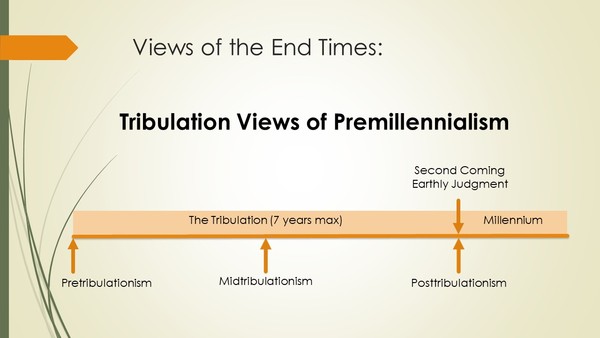
The differences in these previous 4 views all hinge on the relationship between the Second Coming of Jesus and the millennium.  However, within the Premillennialist camp there are some differences that hinge upon the relationship of the rapture to the Second Coming of Christ.  Parenthetically, if you are unsure about the meaning of the word “rapture” then you should see the previous blog post (Sept. 22, 2019).  Thus, last week we looked at the first of these rapture theories within the Premillennialism, Posttribulationism.  It was the view that the rapture is just one aspect of the resurrection, which only happens during the Second Coming of Jesus and after the Tribulation.  Today we are going to look at a second view within Premillennialism called Midtribulationism.  Here is a picture to get a rough approximation of the different views on the rapture within the Premillenialist group.

As you can see The Tribulation is a seven-year period of difficulty which involves the wrath of God upon the earth and ends with the Second Coming of Jesus.  Today’s view believes that the rapture is an event separate from the Second Coming of Christ at the end of The Tribulation.

Is there a rapture of Christian’s before The Tribulation?

The Midtribulation Rapture view says, “No,” to this question.  By the way, there is a minority view called the Pre-Wrath theory, which is similar to the Midtribulation view, but puts the rapture at the ¾ point of The Tribulation.  However, it is not very common and is similar to the Midtribulation view.  So, what does Midtribulation Rapture teach?

First, they believe that Christ raptures his Church in the middle of The Tribulation, which is clearly divided into two 3 ½ -year periods in Scripture.  Second, they see the first half of The Tribulation as being the same as the seven seals and the seven trumpets of the book of Revelation (Rev. 6-11).  The second half is connected to the seven bowl judgments.  Third, they emphasize that the first half of the tribulation is the wrath of man, whereas the second half is the wrath of God.

Argument 1.  Let’s take some time to walk through some of their arguments and give some kick back to them.  They typically emphasize the many places in the Scripture where 3 ½ years are emphasized in relation to end times matters.  Here are a couple of passages that give us such details. 

Look at Revelation 11:3. Here, John is told of two witnesses that will prophesy for 1,260 days and then be killed in the city of Jerusalem (vs. 8).  1,260 days is basically 3 ½ years, and represents the first segment connected to The Tribulation.  These witnesses are killed by the beast that ascends out of the bottomless pit (a prison for spirit beings).  We are told that no one can touch the two witnesses until they finish their witness to the world, and then the beast will have the power to kill them.  Now, let’s go to Revelation 13 to get some more information regarding this beast character.

In verses 4-5, we see that the beast is given authority to continue for 42 months.  Interestingly, this just another way of referring to 3 ½ years.  From Revelation 19, we know that the beast will be captured and thrown into the Lake of Fire at the Second Coming of Jesus.  Thus, a rough timeline of The Tribulation would be: 3 ½ years for the ministry of the two witnesses, and 3 ½ years for the authority of the beast.

Let’s dig a little deeper on these references to 3 ½ years.  Daniel 9:24-27 involves a prophecy wherein 70 groupings of seven years are determined for God’s prophetic dealings with Israel (totaling 490 years).  These groupings of seven years are broken up into 3 groups: 49 years (7 sevens), 434 years (62 sevens, and the last is 7 years (1 seven).  It is this last seven that we want to focus upon because of what it says about it in verse 27.  We are told that the previous period of 62 sevens would end with the death of Messiah.  “Messiah shall be cut off, but not for Himself; and the people of the prince who is to come shall destroy the city and the sanctuary.”  So, after the death of Jesus there was only a period of seven years left for God to complete all prophecy with Israel.  We are told in verse 27 that “the prince who is to come” will strengthen and confirm a covenant with Israel for 7 years.  In the middle of the seven-year period, he will stop the sacrifices and bring in the abomination of desolation, which involves worship of a false god in the temple.  Again, a clear reference is made to a turning point at the 3 ½ year point.  This also synchronizes with Revelation 13 and the beast who has a mouth speaking blasphemies.

We are also told in Revelation 11:2 that Jerusalem will be trampled for 42 months (3 ½ years)-I would assume that this is in the second half under the beast’s authority.  Likewise, Revelation 12 speaks of the Jewish remnant fleeing into the wilderness, being protected from Satan, and being nourished for 1,260 days (again 3 ½ years).  It also describes this period as “a time (1), times (2), and half a time (½).”  This too would equal 3 ½ years.

Clearly, the midpoint of The Tribulation is an important part of the end times.  Yet, do these passages connect this midpoint to the rapture of the Church in any way?  My short answer is that most of the passages make no connection to the rapture of the Church, and the few, where a case is made, are very stretched connections.

Argument 2.  Typically, Revelation 11 and the two witnesses become a key argument.  They are killed by the beast, left to rot on the streets of Jerusalem, and then resurrected and raptured by God after 3 ½ days (Rev. 11:5-12).   These two witnesses are very reminiscent of Moses and Elijah because of what they do.  They shut the heavens so that it doesn’t rain, they turn the waters into blood, and they cause plagues.  Here is the question.  Are they actually two individuals or are they a symbol of the Church?  As you read through the passage, you can see where they could be a symbol in a few places.  However, the details are so clear and specific that it becomes increasingly harder to make it fit with a symbol.  What is symbol and what is not?  How does one make that distinction?  Are all these things symbols: the two witnesses, their death, the streets of Jerusalem, standing on their feet, their rapture, the voice, etc.  It seems a stretch to take all of this symbolic and it seems a stretch to only take the two witnesses as a symbol.  There is nothing textually connecting this resurrection of two individuals to the Church as a whole.  Will all believers on the earth lay on the streets of Jerusalem dead for 3 ½ days?  It seems not likely, especially since the passage gives no implication to this in any overt way.  It seems that these two witnesses represent the grace of God to those who are about to be tempted to take the mark of the beast and pledge allegiance to him and his system.  At this point in our history, modern man will demonstrate that it is one in spirit with the first century world, which crucified the Lord of glory.

This is the only passage that has a direct connection to a resurrection of any kind at the middle of The Tribulation, but yet falls short of a resurrection of all the Church.

Argument 3. The next argument uses 1 Thessalonians 5:9 to argue that “God did not appoint us to wrath, but to obtain salvation through our Lord Jesus Christ.”  To them, this means that God will rapture his Church before he pours out his wrath.  However, Midtribulationists view only the 2nd half of The Tribulation as the wrath of God.  Is this a legitimate claim?  Are only the bowl judgments in the 2nd half of The Tribulation connected to God’s wrath?  The short answer is no.

If you look at Revelation 6:15-17, we have the sixth seal broken and the people of the earth are recognizing that the wrath of God has come, not “is coming.”  By their own testimony they are looking at what is happening and saying, “Oh, No, the Bible was right!”  We can also recognize that there may be some “wrath of man” in the seal judgments (note that the first seal releases a conqueror on the earth, the second releases war etc.).  However, they are all being initiated by Jesus opening each seal.  The implication is clear and obvious.  He is removing the restraints to taking up his rightful authority over the earth.  This document proves his right and is being opened in order to do so.  These seal judgments and the Trumpet judgments later are all seen as the wrath of God.

Along with this, it is very common throughout the Old Testament to speak of events that are “the wrath of man,” and yet explain that they are primarily the wrath of God.  A case in point is the destruction of Jerusalem and the exile of the people of Israel.  No angels were involved in its destruction and their deportation.  However, the prophets testified that the wrath of God had come upon Israel, even though Nebuchadnezzar was his instrument.  Thus, it is a false distinction to emphasize the wrath of God against the wrath of God.

Argument 4.  It is also common to take the trumpet of 1 Corinthians 15:52 and connect it to the seventh trumpet of the book of Revelation.  Here is 1 Corinthians 15:51-52. “51 Behold, I tell you a mystery: We shall not all sleep, but we shall all be changed— 52 in a moment, in the twinkling of an eye, at the last trumpet. For the trumpet will sound, and the dead will be raised incorruptible, and we shall be changed.” (NKJV).  Definitely, Paul connects the rapture/resurrection with the sounding of “the last trumpet.”  We can also note that the seventh trumpet is the last of the trumpets in the book of Revelation and happens right after the killing of the two witnesses, aka midpoint of the tribulation.

So, is there anything in the description of the seventh trumpet in Revelation 11:17-18 that would lead us to believe that the rapture occurs here?  I don’t believe so.  The trumpet blast is followed by a declaration that the kingdoms of this world now belong to the Lord Jesus, and that he is going to rule forever.  It is then that the 24 elders who surround the throne of God in the heavens make several statements.  They do mention that the time has come that the dead should be judged, which by extension would involve resurrection.  Also, the reward of the saints is mentioned, which also would involve resurrection.  However, this passage has the sense of declaring that these things are on the horizon (have come).  The world has been waiting so long and now the time has come for these things to be accomplished, not that they have already been accomplished.  In fact, if all these things are done at this point, then the whole bowl judgments seem out of place.  Christ doesn’t come down to reign for another 3 ½ years.  How can he have already reigned, and judged the dead, and rewarded the saints?  There is no clear statement that a resurrection of the saints happens at the 7th trumpet of Revelation.

Furthermore, It seems a stretch to think that Paul, who wrote 1 Corinthians 30 years earlier to John’s Revelation, had in mind the same thing John does.  John is revealing a vision that he has had.  Most of Revelation is stuff that has no New Testament connection.  It is a fresh revelation from God that is clearly giving information that the apostles did not have before this.  Yes, the Holy Spirit could have directed Paul to put down a phrase that he had no clue why he should include it, but this seems to run counter to what Paul is saying.  He has a clear reference in mind when he mentions the last trumpet.  On the other hand, the book of Revelation never calls the seventh trumpet, “the last trumpet.”  Yes, it is logically the last of those seven, but nowhere is it called the last trumpet.  Such, a connection is extremely tenuous, at best.

Let me reiterate that I appreciate that these views attempt to take Bible prophecy literally.  I believe that it is the approach that God would have us use.  Yet, people who hold one of the three Premillennial views of the rapture have not been very kind to each other historically.  In truth, they are often quite nasty, employ ad hominin attacks, and demonstrate extreme arrogance.  This is sad because our lord literally tells us not to do such things.  Even if you believe that a fellow Christian is wrong in their interpretation, you are still required to love them.  On top of this, no view of the rapture involves heresy that will endanger anyone’s salvation.  This is simply an over the top line of reasoning.  Our salvation is not based upon our view of the rapture.

May God help us to endeavor to be a people that will trust God regardless of what we are required to endure because there are people every day who are not in The Tribulation, and yet, they wonder if they can endure the things that they are facing right now.  They need strong Christians who can come alongside of them and encourage them with the truth of God.  Yes, God allows us to go through difficult things, but he also has a good plan for us.  He is not allowing us to suffer needlessly.  Instead, our lives are a witness to the world around us, and a witness against the fallen heavenly powers.  “We choose Jesus!  We choose to follow Him, and not the false pretenders who come to replace him!”

Midtribulationism audio

Page 1 ... 4 5 6 7 8 ... 13 Next 4 Entries »