Archives
Tag Cloud
Abandonment Abomination of Desolation Abortion Abraham’s Bosom Abuse Acceptance Accounting Accusation Activism Adoption Adornment Adultery Adversary Adversity Affection Affliction Afterlife Allegory Alliances Altar Ambition America Analogy Angel of the Lord Angels Anger Anointed One Anointing Antichrist Anxiety Apologetics Apostasy Apostle Apostles Armor Armor of God Arrest Ascension Asceticism Ashamed Assembly Assurance Atonement Attitudes Authorities Authority Baal Babylon Bad Baptism Battle Behavior Belief Believer Believers Benefits Benevolence Bethlehem Betrayal Bible Bitterness Blasphemy Blessed Blessing Blessings Blindness Boasting Body of Christ Boldness Bondage Book of Life Borders Born Again Borrowing Bottomless Pit Bride Bride of Christ Bridegroom Brokenness Brother Built Up Burden Caesar Calling Capital Punishment Care Cares Carnal Cast Away Casting Lots Caution Celebration Chaos Character Charity Chaste Childbirth Children Children of God Choice Choices Chosen Christ Christian Christian Life Christianity Christians Christmas Church Circumcision Circumstances Citizenship Civil Disobedience Clay Cleansing Comfort Commands Commitment Commune Communion Community Comparison Compassion Complacency Complaining Complementarianism Conception Condemnation Conduct Confession Confidence Conflict Conform Conforming Conformity Confrontation Confusion Connect Connection Conscience Consecration Consequences Contempt Contention Contentment Contrition Conversion Conviction Cornerstone Correction Cost Counsel Courage Covenant Coveting Creation Creator Crisis Cross Crowd Crowds Crowns Crucifixion Cults Culture Curse Danger Darkness David Davidic Covenant Day of the Lord Day of Visitation Deacons Deaf Death Deceit Deception Decisions Defense Defilement Deity Delegation Delight Deliverance Delusion Demon Demon Possession Demons Denial Dependency Design Desire Desolation Desperation Destruction Devil Devotion Diaspora Direction Disaster Discernment Disciple Disciples Discipleship Discipline Discontentment Discouragement Disease Disgrace Dishonesty Disputes Dissension Distraction Diversity Divine Divine Appointment Divinity Division Divorce Doctrine Dominion Donation Double Fulfillment Doubt Drought Drugs Duties Duty Earth Earthly Earthquakes Easter Edification Edom Education Egalitarianism Elders Elect Elijah Elohim Emmaus Emotion Emotions Employment Encouragement End Times Endurance Enemies Enemy Enoch Environment Environmentalism Envy Equality Equipped Established Esteem Eternal Eternal Life Eternity Evangelism Evangelist Everlasting Life Evil Evil Spirits Evolution Exaltation Exalted Example Exclusion Excuses Exorcism Expectations Eyes Failure Fairness Faith Faithful Faithful Servant Faithfulness Fall Away False Christ False Christs False Conversion False Doctrine False Gods False Prophet False Prophets False Religion False Religions False Teachers False Teaching False-Humility Family Famine Fasting Father Father God Father’s Day Fathers Favor Favoritism Fear Fear of God Fear of the Lord Feasts Feasts of the Lord Fellowship Female Fervor Fig Tree Fights Finances Fire First Coming First Resurrection Firstborn Flattery Flesh Flock Flock of God Folly Foods Foolish Foolishness Foreigner Foreknowledge Foreknown Forgiveness Fornication Forsaken Foundation Free Will Freedom Friends Friendship Fruit Fruit of the Spirit Fruitful Fruitfulness Fulfillment Function Futility Future Gehenna Generosity Gentile Gentiles Gentle Gentleness George Wood Giants Gifts Giving Globalism Glorified Body Glory God God the Father God’s Will God’s Word Godhood Godliness Godly God's Will Golden Rule Good Good News Good Shepherd Good Works Goodness Gospel Gospels Government Grace Gracious Gratitude Grave Great Commission Greatness Greed Grief Grow Growth Guilt Hades Hardship Harvest Hate Hatred Headship Healing Heart Heaven Heavenly Heavenly Father Hedonism Hell Help Herod Hesitation Hidden High Priest Holiness Holy Holy Spirit Home Homosexuality Honesty Honor Hope Hopelessness Hospitality Hostility House of God Human Frailty Humanism humanity Humility Husband Husbands Hypocrisy Hypocrite Hypocrites Identity Idolatry Ignorance Image Image of God Immanuel Immigration Immortal Immortality Impossibility Incarnation Individuals Indulgences Indwelling Infilling Inheritance Injustice Inner Battle Innocence Instruction Instructions Insults Integrity Intercession Intermediate State Interpretation Intervention Intoxication Israel Jerusalem Jesus Jewish Temple Jews John the Baptist Joy Judas Judge Judging Judgment Judgment Day Judgments Justice Justification Justify Key Keys Kids Kindness King Kingdom Kingdom of God Kingdom of Heaven Kinsman Knowledge Labor Lake of Fire Lamb of God Lamp Last Days Law Law of Moses Law of the Lord Lawlessness Lawsuits Leader Leaders Leadership Leading Leftism Legal Legalism Leprosy Lies Life Life-Span Light Light of the World Like-minded Listening Living Stone Lonely Lord Lost Love Lovingkindness Lowly Loyalty Lust Lusts Luxury Lying Magdalene Magic Malachi Male Manipulation Marriage Martyr Martyrdom Martyrs Mary Master Masters Materialism Maturity Meditation Meekness Men Mentoring Mercy Messiah Metaphor Millennium Mind Mind of Christ Minister Ministry Miracle Miracles Mission Missionary Missions Mocking Money Morality Mortal Mortality Mother’s Day Mothers Mother's Day Mt. Sinai Murder Mystery Nations Natural Natural Gifts Naturalism Nature Nazareth Near-Far Fulfillment Necessities Neglect Negligence New Birth New Covenant New Creation New Earth New Heavens New Jerusalem New Man New Self New Testament Oaths Obedience Obstacles Obstructions Offense Offenses Offering Old Covenant Old Man Old Nature Old Self Old Testament Omnipotence Omnipresence Omniscience One Mind Opportunity Orderly Others Outcast Overseer Overseers Oversight Pagan Pain Palm Sunday Parable Parables Paradise Paranormal Pardon Parenting Passion Passover Path Patience Patriotism Peace Peer Pressure Pentecost People of God Perception Perfect Perfection Persecution Perseverance Persistence Personal Injury Personal Testimonies Perspective Persuasion Perversion Perversity Pestilence Peter Petition Pharisees Philosophy Piety Pilate Pilgrim Plan Plans Pleasure Politics Poor Pornography Position Possession Possessions Posture Power Praise Prayer Preach Preaching Preparation Preparedness Presence Preservation Pretense Pride Priesthood Principles Priority Prison Privilege Prodigal Profane Profession Promise Proof Prophecy Prophet Prophets Prosperity Protection Protestant Reformation Proverbs Providence Provision Pruning Punishment Purgatory Purification Purity Purpose Purposes Questions Racism Raised Ransom Rapture Readiness Reason Rebellion Rebuke Receiving Reconciliation Redeemer Redemption Refuge Regeneration Rejection Rejoice Rejoicing Relationship Relationships Relativism Reliability Religion Remember Remnant Renewal Repentance Reputation Resolve Rest Restoration Resurrection Retribution Revelation Revenge Revival Reward Rich Riches Ridicule Righteous Righteousness Rights Riot Risk Ritual Rivalry Robbery Roman Catholic Church Rooted Rule Rulers Rumor Sabbath Sacred Sacrifice Saint Saints Salvation Sanctification Sanctuary Sarcasm Satan Satisfaction Savior Schemes Science Scoffers Scripture Seal Seasons Second Coming Second Death Secret Sedition Seed Seek Self Self Control Self-centered Self-Control Self-Denial Selfish Ambition Self-Preservation Self-Righteous Servant Servant-Leadership Servants Serve Service Serving Sexual Immorality Sexual Sin Sexuality Shame Share Sharing She’ol Shepherd Shepherds Sickness Signs Signs and Wonders Silence Simplicity Sin Sincerity Sinful Nature Singing Singleness Sinner Sinners Slander Slave Slavery Slaves Sober Sobriety Socialism Society Sojourner Sojourners Son Son of God Son of Man Sons of God Sorcery Sorrow Soul Source Sovereignty Speech Spirit Spirit Baptism Spirit Beings Spirit Realm Spirit-Led Spirits Spiritual Spiritual Adultery Spiritual Battle Spiritual Birth Spiritual Condition Spiritual Death Spiritual Gifts Spiritual Growth Spiritual Maturity Spiritual Powers Spiritual Rulers Spiritual Warfare Steadfast Stewardship Storms Stranger Strength Stress Strife Strong Struggle Stumble Stumbling Block Subjection Submission Substitution Suffering Suicide Supernatural Supper Supremacy Surrender Survival Swear Symbols Syncretism Tabernacle Tags: Patience Taxes Teacher Teachers Teaching Teachings Tears Technology Temple Temptation Temptations Tenderness Terminal Illness Test Testify Testimony Testing Tests Textual Issues Thankfulness Thanksgiving The Beast The Curse The Day of The Lord The End The Faith The Fall The Gospel The Grave The Great Tribulation The Holy Spirit The Lamb of God The Law The Law of Moses The Mind of Christ The Secret Place The Way The Word The World Theft Theology Thought Life Threats Throne Time Time of Visitation Times of the Gentiles Timing Tithing Tongues Tower of Babel Tradition Tragedies Tragedy Training Transfiguration Transformation Traps Treachery Treasure Tree Tree of Life Trial Trials Tribulation Trifles Trinity Triumphal Triumphal Entry Trouble Trust Trustworthy Truth Tyranny Unbelief Unbelievers Uncertainty Underground Church Understanding Unfaithfulness Ungrateful Unity Unpardonable Sin Utopia Value Vengeance Victory Vigilance Vindication Virtue Virtues Vision Visions Visiting Ministries Voice of God Volunteer Volunteers Vow Vows War Warfare Warning Warnings Wars Watch Watching Water Baptism Water of Life Weak Weakness Wealth Weary Wicked Wicked Plans Wickedness Widows Wife Will Wineskins Wisdom Witness Witnesses Witnessing Wives Women Wonders Word Word of God Word of Knowledge Word of the Lord Work Works World World View Worry Worship Worth Worthy Wounds Wrath Yahweh Yeast YHWH Yoke Zion

Weekly Word

Entries in Suffering (38)

Sunday
Mar222020

Greatness is in Serving

Mark 10:35-45.  This sermon was preached by Pastor Marty Bonner on Sunday, March 22, 2020.

It is easy in our country to give lip service to the issue of being a leader who serves the people.  Our Christian foundations have affected the ways that we talk about such things, and even the words used by some politicians to manipulate people into voting for them.

In the last sentence of the Gettysburg Address, President Lincoln challenged the nation with these words.  “It is rather for us to be here dedicated to the great task remaining before us – that from these honored dead we take increased devotion to that cause for which they gave the last full measure of devotion – that we here highly resolve that these dead shall not have died in vain – that this nation shall have a new birth of freedom and that government of the people, by the people, for the people, shall not perish from the earth.”  Our human tendency, in its immaturity, is to look for leaders who will tell us what to do and to save us from threatening conditions.  However, our country was built upon the premise of a government that is made up of the people who are governing themselves for the sake of the whole nation.  The ability of the group to govern lives or dies upon the ability of individuals to govern themselves.

The founding fathers were working off of a biblical foundation and world view.  God’s word challenges believers to walk in freedom, but not a freedom to do whatever you want.  In our passage today, Jesus teaches us how leadership should work in the Church, and it is the opposite of how this world tends to do it, regardless of what words they use.

The request of James and John

Our passage begins with a request that comes from the two disciples, James & John.  They are brothers who had been fishermen on the Sea of Galilee just like Peter and Andrew.  It is worth noting that Matthew 20:20-28 tells us that this request was actually made through their mother.  Since this is not in our passage today, I will only make a passing comment.  No doubt, James and John knew that this request was in bad taste and bad form.  They attempted to moderate its ambitious nature by having their mom ask.  However, Jesus addresses them and not their mother.  That coupled with its absence in Mark’s account tells us that everyone knew James and John were ultimately behind the request.

Their request is this.  “Grant us that we may sit, one on your right hand and the other on your left, in your glory.”  It has two parts.  First, they want to have the highest place next to him.  And, second, the time frame that they are talking about is “in his glory.”  This is directly referring to the time when he would be ruling over Israel as the promised Messianic King in what is generally called the Kingdom of God.  We would call this the Millennial Kingdom, which they thought would begin shortly.

Now, to give them some credit, Jesus had already told his disciples in Matthew 19:28 that “in the regeneration [the resurrection], when the Son of Man sits on the throne of his glory, you who have followed me will also sit on twelve thrones, judging the twelve tribes of Israel.”  So, he had already promised them a high position in his coming kingdom.  They are not content with that apparently, and desire to ask for the two top spots.

What we are going to see in this passage is that the problem is not that we might desire great positions or even to do greatly in those positions.  The real problem is that our desires are riddled with impure motives and misunderstandings of just what true greatness is.  They want the highest positions to be given to them outright before they have done anything to deserve it.  Instead of seeking to promote ourselves further in this life, we should focus on serving well in the position that we are in right now.  If God promotes us beyond that position then that is His prerogative, and if He doesn’t then we should not take it as a slight.  It really doesn’t matter what our placement in the age to come is going to be.  What really matters is our service for the Lord today.  How is my service?

Jesus prefaces his response to James and John with the statement that they don’t realize what they are asking.  When we ask for promotion, we generally only see the “good” things connected to being the boss.  Yes, we see power, authority, freedom to do what you want, people looking up to you, and a great reputation.  It is like looking at a virtuoso who plays their instrument so well and wanting to do what they do.  It only takes a week of practicing (and sometimes less) to realize that 99.9999% of us really do not want to be a virtuoso.  We tend to want the good stuff of being a virtuoso without the grueling and unrelenting practice, a.k.a. price, that goes with it.

So, Jesus gives them two metaphors to help us understand the hard part of getting those two top spots.  The first metaphor is that of a cup that one has to drink.  It is clear that he is talking about his upcoming sufferings.  In the garden on the night he was betrayed, Jesus asks the Father to take this cup away from him.  He ends by saying, “Nevertheless, your will be done.”  The picture is of a cup that is filled with suffering and you are being asked to drink it.  Most people would take a sip and cast the cup aside.  We are typically unwilling to drain it to its dregs.  However, Jesus did drink the cup to its dregs, and he asked his disciples to pick up their cross and follow him.

The second metaphor is that of something into which they need to be baptized (immersed).  This is a full body immersion into a particular pain and difficulty that goes along with doing the hard work that God has called him and us to do.  Both metaphors work together to show us the internal and external suffering that goes along with doing God’s will.

Our future kingdom rewards in the Millennium are directly related to the hardships and sufferings that we have gone through in this life in order to accomplish God’s will.  The suffering itself is not what we seek.  It is not suffering in general that gives us reward.  It is the particular suffering that comes from doing the will and purpose of God.  As we do God’s will, certain hardships and sufferings will arise up and threaten to turn us back.  Christ will reward those who press through the sufferings in order to serve his purposes.

In response to the challenge that Jesus gives to them, James and John both declare that they are able to drink this cup and be baptized with this baptism.  It is not clear just what they think this means, but even if they understood that it involved suffering, they would be inclined to think that this suffering would be very quick and the glory would come soon.  Jesus then agrees that they are right.  They will drink this cup of suffering and be baptized in this pool of suffering in following him.  Acts 12:2 tells us that Herod Agrippa had James executed and then seized Peter to do the same.  Peter escapes by the help of an angel from God.  Why didn’t James have an angelic escape?  It has nothing to do with which of them was a better disciple or had more faith.  It had to do with the purposes of God in their life.  The apostle James became the first of the 12 to be put to death for Christ.  On the other hand, the apostle John is the last of the 12 to die.  The Bible does not record his death, but we have several stories from the 2nd century that say that there were attempts to kill John that did not work.  They poisoned him, but he still lived.  They threw him in boiling oil and survived.  Then he was exiled on the island of Patmos where he wrote the Revelation, the last book of the Bible.  His suffering was a long slow burn that was different then his brother.

Jesus ends this point about suffering by telling them that it is not up to him who gets these positions.  The positions are for those “for whom they have been prepared.”  The emphasis is not on the fact that Jesus has no say, but rather on his ability to give the positions in the way James and John are asking, as a favor.  Jesus cannot just give them out to family members or favorite disciples.  The emphasis is on how they are to be handed out.  Isaiah 11:3-4 tells us that the Messiah would not judge by what he sees or hears, but rather in righteousness.  In other words, he won’t judge like we do.  His judgments will be perfect and just right.  Thus, Jesus would not agree to favoring James and John.  Instead, they would receive what they deserved in the Kingdom.

Make no mistake.  God will reward us for our faithfulness in the face of difficulty and suffering, but let’s trust Him to make the measurement of our service and determine what it deserves.  Self-ambition can side-track the true work that must be done in our hearts in order to save people who are lost.

Jesus teaches on greatness

This sets up a situation for Jesus to remind his disciples about leadership in God’s Kingdom, whether now or in the age to come, in verses 41-45.  God does not see leadership like we do.  Our flesh gets mixed up in how we approach it.

However, let’s deal first with how the other disciples respond to this request of James and John.  They are angered, and greatly displeased.  We should stop and ask why they are angry.  If the Messiah, Jesus, only judges based upon righteousness and doesn’t play favorites then what do they have to fear?  I believe that they are angry because they desired the same thing and were afraid that the audacity of James and John just might secure the positions for them.  Their own sinful flesh is annoyed at the thought that those two might get ahead of them.  They knew that it wasn’t right to ask for such things, but in their hearts, they still desired it.

We need to stop such nonsense.  Promotion is not all that it is cracked up to be.  The more people you are called to lead the harder the burden is upon your shoulders.  We should neither shrink back from promotion out of fear or laziness, nor should we grasp at it out of selfish ambition.  Let’s simply trust God to direct our lives into the positions that he has for us, both in this life and in the next.  He is just and does all things well.  We should not wrestle against one another like these disciples were doing.

In verse 42, Jesus then points out how the Gentile leaders act.  Yes, they exercise authority over their people, but the operative phrase is, “Lord it over them.”  It is the idea of dominating and bringing those under your authority into subjection.  It is a heavy-handed leadership.  This tends to be the case among the nations because they didn’t have the teachings of God’s Word and such leadership tends to be very productive and focused.  It often gets results in this life.

This is not the kind of leadership that God wants among His people, both in this life and the life to come.  In fact, let’s remember that God Himself is not nearly as heavy-handed in His leadership as people often like to accuse Him of being.  He gives us room to repent and choose how we will live our life.  He wants us to choose love and service to Him freely, rather than to be subjugated into such roles.  Sadly, many leaders of the Church today and throughout history have failed in this respect.  Many of the great leaders throughout history are not great in God’s eyes.  They failed miserably to demonstrate the image of God to those they were tasked with leading.  We must not look to the greats of this world to determine how we should lead the Church of Jesus.  We must look to the greatest leader, Jesus.

Jesus counters the Gentile-way with how it should be among the Church.  Those who want to be great must become a servant.  Jesus had already told them this back in Mark 9:35 when he brought a little kid in their midst.  They had been arguing that day about which of them was the greatest, that is deserved the number one spot next to Jesus.  In our passage today, they have not learned their lesson, clearly.

Those who want to be great in the Kingdom of Jesus, both now and in the Millennium, must become a servant to everyone else.  Instead of using your position to build your reputation and personal kingdom, you must always recognize that you are not a god to the people you lead, but rather you are to represent “The God of Heaven” to those you lead.  You are to be a servant, not just to God by doing His purposes, but also to individuals by meeting the needs in their life that God sends you to meet.

The phrase that has been connected to this teaching is “Servant-Leadership.”  Among Christ’s Church, this is the only leadership that is acceptable to him because it is the only leadership that truly reflects him to believers and the world.  Christ has made you free, now use your freedom to serve your fellow man in regards to God’s purposes in their life.  Whatever level of leadership you have, parents with children all the way up to denominational leaders to their churches, we must learn to reflect Christ in our leadership.  The children and the people are not yours to do with what you want.  They belong to God and you will be rewarded or not for how you led them to walk in their own freedom before God.

In case this point hasn’t hit home, Jesus uses himself as an example.  Everyone agrees that he should get the first place, but how did he get first place?  How did he lead.  The Father didn’t just give it to him because he was his favorite son.  Jesus earned first place by coming down, humbling himself, taking on the nature of a man, and becoming a ransom for you and me.  Some people have rejected this notion of Jesus being our ransom because they think it sounds barbaric and uncouth.  Why can’t God just decree that we are all saved?  Such a question goes to the heart of the issue and why we tend towards totalitarianism instead of freedom.  Humans are always looking for techniques and tools to bring the world around them under their desires, but God simply serves people with the things that they actually need, and not to manipulate them.  Instead, He is willing to suffer in order that we might be free to choose life or death.  Choose life this morning and not death.  Put your faith in the one who has paid the ransom to free you from sin and judgment.  Become a follower of Jesus today if you aren’t already, and learn from him what it means to be great in God’s eyes.

Greatness is in Serving audio

Tuesday
Mar172020

Jesus Foretells His Future a Third Time

Mark 10:32-34.  This sermon was preached by Pastor Marty Bonner on Sunday, March 15, 2020.

I am always a bit leery of using the word “foretell” with Jesus or his prophets because it has connotations that are more associated with fortune tellers and those who try to predict the future.  Jesus, however, was not a skilled fortune teller, nor was he a skilled political analyst who was able to see what would happen in the future.  Rather, Jesus is telling them before hand what will happen in the future because he and the Father have discussed this in heaven.  Jesus had come down as the One and Only Unique Son of God.  It was the plan of God for the things we will discuss today to happen.  This does not mean that God is forcing the wicked players involved to do what they do.  Instead, God incorporates their willful rebellion into His plan.

In Mark’s Gospel, he wants us to be clear that Jesus knew that the events leading up to the crucifixion were coming.  Jesus had taught his disciples that rejection was part of God’s plan.  Though the leaders of Israel would cast Jesus aside, The Father would overrule their decrees.

Let’s look at our passage today.

The last march up to Jerusalem

Mark 10 begins a transition in the book.  It opens in verse 1 telling us that Jesus was in the region of Judea on the other side of the Jordan.  In these verses today, they are on the road to Jerusalem.  At the end of the chapter, they will be in Jericho.  Thus, they are somewhere between the other side of the Jordan and Jericho at this point.

Mark 11 opens with the Triumphal entry, which occurs less than a week before the crucifixion.  This is how close we are in this passage to the death and resurrection of Jesus.

Mark tells us in this passage that the disciples are amazed and that they are afraid.  They are afraid because Jesus is going up to Jerusalem and the religious leaders were trying to get Jesus.  This is interesting because the disciples believe to things that are in tension with one another.  On one hand, they are finding it hard to believe that the Messiah would actually be killed.  Yet, on the other hand, they are definitely afraid of the intentions of the religious leaders.  This is not a contradiction.  The tension is between what they believe should happen, according to the prophecies about the Messiah, and their knowledge that the very powerful leaders are seeking to arrest Jesus and perhaps them.  The Gospels all tell us that Jesus warns his disciples multiple times about his coming death, and many people were warning them that the religious leaders were out to get them.  So, this explains their fear, but what is amazing them?

In contrast to the disciples, we are told that Jesus is leading in front of them.  He is purposefully headed towards Jerusalem and they are amazed at his fearless approach to the city that held so much danger for them.  Jesus is not sneaking under the cover of darkness, nor is he keeping a low profile (at Jericho he heals the blind Bartimaeus).  He is not leading from the back of the group, or from the center as an attempt to protect himself.  Rather, he is leading in front of them, like a true Captain of our salvation.

Of course, I use that terminology because the writer of Hebrews 2:10 gives this image to us.

“For it was fitting for Him, for whom are all things and by whom are all things, in bringing many sons to glory, to make the captain of their salvation perfect through sufferings.”

Jesus was a fearless leader because his relationship with the Father was inseparable and without doubt.  He marches in front of us, even today, but not so much in front that the weak are left behind.  Thus, we see Jesus sensing their fear of what lies ahead, and yet their amazement at his bold march towards certain trouble.  He stops and takes time to speak to them about it.

Sometimes those who lead into difficult times or circumstances are not so noble in their leading.  It is easy to mislead people regarding what lies ahead in order to get compliance or quell panic.  Some may even keep those they lead completely in the dark.  Jesus was not this way.  He is being truthful and honest with the disciples about the difficult things ahead.  Yet, he is taking time to bring them along.  He is modeling for us what it means to carry your cross and follow God’s plan.  No, it is not easy on our flesh, and yes, we must take time to pray and encourage ourselves in what God would have us do despite all of the fearful things that we may see around us.  We also see him modeling how those who are strong in faith should come alongside of those who are not, and encourage them in marching towards the plan of God.

I want to tell you today that Jesus knows your fears about what lies ahead.  By His Holy Spirit, He is marching ahead of you to lead you to the Father, and to perfect that work of God within you.  However, he will stop from time to time in order to draw you near to him and speak the truth to you in love.  Hard times lie ahead, but fear not!  Jesus is with us, even unto the end of the age!  Let us not forget that our Lord has not abandoned us, but that he is marching in front of us.  We can trust his plan because he has proven his heart on the cross.

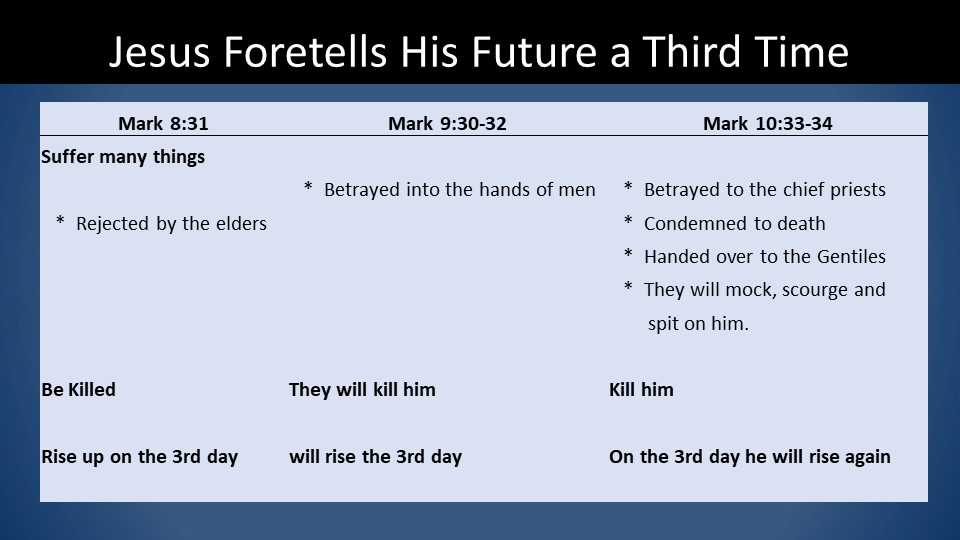
As I said, Jesus doesn’t sugar coat what lies ahead.  This is the third time that Mark describes Jesus telling them about his coming death and resurrection.  More than likely, Jesus had more than these 3 discussions.  Here is a breakout of what Jesus told them in those discussion.

We see that in Mark 8:31 Jesus references 3 main events.  He will suffer many things, which is only detailed by being rejected by the elders.  Then he will be killed, and after that on the third day he will rise again.  We are therefore given a three-stage outline of the events ahead.  His suffering, his death, and his resurrection.  In Mark 9:30-32, the same three stages are outlined, but now we are told that part of his suffering will be in a betrayal.  It is one thing to be rejected by the leaders who never liked you, but betrayal involves someone that is close to you.

In Mark 10:33-34, we again have a reiteration of these three stages with more detail on his sufferings.  He would be betrayed to the chief priests, condemned to death by them, handed over to the Gentiles, mocked, scourged, and spit upon.  This is a pretty detailed list of just how bad things were going to get.  Jesus does not mention what will happen to the disciples here, but they cannot say that he never warned them.

Many Christians around the world today are having to deal with the reality that their future involves many such sufferings, and even the threat of death.  They have to choose whether they are going to follow a Lord that leads them into such difficult and impossible circumstances, or turn back.  We live in a part of the world where it is much easier to follow Jesus.  There are no literal crosses and prison cells directly in our path, but we do see around us a world of chaos that doesn’t know its right hand from its left.

I want to encourage us, but not by sugar coating what lies ahead.  I want to encourage us, but not by freaking out and shouting, “Run for your lives!”  No.  There are many things ahead that you and I will have to suffer.  We don’t exactly know what those things will be for us.  However, Jesus will lead us, and teach us, and give us strength.  He will bring us along until that day that we too breathe our last and leave this earth.  It most likely won’t be on the third day after our death, but we too will rise again.  This is God’s promise to all those who put their trust in Him.  This is our glorious hope.  Do not look to the wisdom of this world to lead us into peace and safety, or to chart a path into a better world.  Yet, do not surrender to fear and desperation.  Our God has a plan through all of this.  He will not abandon us, even though we may face a martyr’s death.  We will rise again, reign with Him, as God fulfills His promise to all those who have waited for Him in trust!  Let’s rise up, follow Jesus, and trust in Him no matter what lies ahead!

Jesus Foretells His Future audio

Tuesday
Jan072020

The Spectacular Transfiguration of Jesus Christ

Mark 9:1-13.  This sermon was preached by Pastor Marty Bonner on Sunday, January 05, 2020.

This passage has a unique event that is more than just your average miracle (if such can be said about miracles).  The transfiguration of Jesus demonstrates that supernatural things are not only happening around Jesus, but that there is also something supernatural about him.  He is not a man who has figured out how to get God to help him all the time.  Rather, his origin is supernatural.  He is from the Father and thus he is from heaven.

Let’s look at the passage.

Jesus gives a promise

The scene begins in verse 1 where Jesus gives a promise to a gathering of his disciples and other people.  This is mentioned in Mark 8:34. The stands out as a singular statement against the event that follows it, the transfiguration of Jesus.  The disciples and the people had been kept guessing as to when Jesus might begin to bring in the Kingdom of God that they were expecting.  Yes, they are grateful for miracles and all, but they want to see Jesus get serious about taking on the greater role of Messiah by kicking out the Romans and reforming the corruption of Israel.

The basic promise is that some of those who were in attendance that day would not die before they saw the kingdom of God coming in a powerful way.  This verse is sometimes used to substantiate the claim that Jesus taught the disciples that his Second Coming would happen in the first century.  Atheists see that it failed and thus reject Christ.  Believers that do this will find events within the first century and present them as metaphorical fulfillments of such promises.

Of course, we should note that the Second Coming is not mentioned in this promise.  It is only about the Kingdom of God and how it would be coming in.  This presents a wrinkle.

The New Testament does present an odd twist on the Old Testament promise of the Kingdom of God.  In short, the apostles proclaim that the Kingdom of God has been established in the hearts of believers through the Spirit of God.  Yet, the physical reign of Jesus (Messiah) on this earth and the judgment of the nations has been put on hold, or is not yet.  So, we get this “now, but not yet” presentation of the Kingdom of God throughout the writings of the Apostles.

Does anything happen within the lifetime of those who were living at that time which reflects the Kingdom of God coming powerfully?  All three gospels that record this bold statement follow it immediately with an account that is called the Transfiguration of Jesus.  It is contextually clear that they saw this event as the fulfillment of what Jesus promised.  Modern sceptics may not like this explanation, but it is the one that the disciples themselves give to us.

For modern people to reject such an explanation, smacks of arrogance.  Who are we to tell people from a culture within which we have never lived that they didn’t actually understand what Jesus said?  Who are we to force our thinking upon the situation?  The disciples present themselves as often misunderstanding Jesus.  They really didn’t “get it” until after the resurrection.  There we have Jesus fully explaining the Scriptures, and another promise that the Holy Spirit would enable them to remember the things Jesus said along with what it meant (John 16:12-13).  The truth they came to see is that the transfiguration was exactly what Jesus was talking about in this promise.  He is not talking about the end times and his Second Coming.

Jesus is transfigured

We are told that Peter, James, and John go up on a high mountain with Jesus six days later.  These three are the “some” that Jesus was talking about in the previous promise.  We are not told what high mountain this is although they were last described as being in the area of Caesarea-Philippi.  So, it could be somewhere in the Golan Heights.  However, the importance of the high mountain is more in its symbolism than it is in its literal location.  There is a clear parallel happening here between Moses going up on the mountain to hear from God at Sinai, and the disciples going up on the mountain and hearing from God with Jesus.  Jesus is the “greater than Moses” one.  Yet, his disciples are the ones who are going to come down from the mountain, and speak to Israel and the nations about what God has told them.

So, what does transfiguration mean?  We should recognize that what is described in this passage did not happen and so they had a word for it.  In seeking to describe what they saw, the disciples take up the Greek word “metamorphosis,” which has the basic meaning of a change of form.  This should not be connected to the concept of shape-shifting, even though the word could allow for it.  Jesus clearly does not change shape, and the word is used in two other places in the New Testament to describe the believer being transformed into the image of Jesus (no literal shape-shifting there either).  Romans 12:2 tells believers that they should not be conformed to this world, but rather to be “metamorphed” by the renewing of your mind so that you might prove what the good, acceptable, and perfect will of God is.  In 2 Corinthians 3:18 the Christian experience is described as one who sees Christ in the mirror of God’s Word and is “metamorphed” into the same image from one level of glory to the next level of glory.  Thus, the change they are describing with the word “metamorphosis” is not about the shape, but rather the outward presentation of the person.  The word appearance would be a better concept here than shape. 

Mark tells us that the clothing of Jesus began to shine exceedingly white.  We can imagine something like a mantle in a gas or oil lamp.  In Matthew 17:2, we are told that his “face shone like the sun.”  Thus, the shining is actually coming from the person of Christ and is affecting his clothing.  Within that culture, such a description would clearly imply that Jesus is not just human.  He is a spirit being from the spirit realm.  Spiritual beings are often described as shining, and even metaphorically referred to as stars or celestial lights.  The intention is clear.  There is something heavenly about this being.  The glorious Son of God was cloaked by human flesh, but in this moment the three disciples are given a glimpse of his true glory, the glory he will have when he returns at the end of the age in order to set up the physical reign of his kingdom. 

This also connects to Moses on Mt. Sinai because there Moses was given a glimpse of the receding glory of God, whereas here, the disciples are given a limited glimpse of the glory of Christ.

It is amazing enough that Jesus is shining like the sun, but then two figures appear and begin talking with Jesus.  The disciples come to know that they are Elijah and Moses (probably through what they say).  These two men are representatives of the Law and the Prophets.  They both were remembered as operating in powerful signs and wonders.  This also underlines what Jesus taught elsewhere.  God is not the God of the dead, but of the living.  Those who have gone before us are still alive.  They are just not in earthly bodies.

So, what are they talking about?  We are not told.  Yet, it is reminiscent of the angels who appeared to Jesus in the wilderness after his 40-day fast and tempting by the devil.  They may be simply encouraging him for the road of suffering that lay ahead.

Although this scene is still happening, we are told that the disciples are very afraid.  In his fear, Peter asks Jesus if they should build three tabernacles for Jesus, Moses, and Elijah.  This glorious appearing of Jesus along with the powerful prophets of old was more like what the disciples had been wanting.  A glowing, shining Messiah should have a tabernacle in which to dwell.  The word for tabernacle is the same word used for the portable temple that Israel used in the wilderness wanderings coming out of Egypt.  It was later replaced by a permanent temple.  Perhaps Peter sees that this could be a religious site of worship, and a political site of the rule of Messiah.  Clearly, they needed to be silent and just watch.  The impulsive nature of Peter causes him to interject an idea that will not even be considered.  Peter does not understand what God is doing, and in a sense is interrupted by the Father Himself in what happens next.  We must be careful that we are not building things that are not what God is desiring, even though they sound thoughtful and worshipful.

At this point, a cloud overshadows them and a voice speaks from the cloud to them.  It says, “This is my beloved Son.  Listen to Him!”  The suffering and death that Jesus was going to experience would threaten their perseverance in listening to Jesus and following him.  This event serves to show that, no matter how inglorious the life of Jesus would look, he was the very glory of God.  The disciples could trust the one who would become the crucified Lord of Glory.  This is also God’s word to you and I.  God commands all men everywhere to repent of their sins and listen to Jesus.  This also connects back to the cloud that led Israel through the wilderness and would descend on the tabernacle when Moses would meet with God to receive His words.  The cloud was a visible sign that God’s presence was there.  No Israelite would miss the connotation of what is happening here. 

On top of this, Moses told Israel in Deuteronomy 18:15 that God would eventually raise up another prophet like him and that they should listen to him.  This is the exact same message that the father gives to the disciples.  Listen to Him!

The scene suddenly disappears.  The cloud, Moses, and Elijah are all gone.  Jesus is not glowing anymore.  At this point, Jesus instructs his disciples that they should not tell anyone about this event until after the Son of Man has risen from the dead.  They are still stupefied by these references that Jesus keeps making about the Son of Man being killed and then rising from the dead.  It just goes to show how hard it is for us to see things that are right in front of us when we are not expecting them, or they are so far outside of our frame of reference.  Later, the disciples would tell all about this event as they spoke to Israel and the nations.  Peter clearly mentions this event in 2 Peter 1:16-19 where he says, “We did not follow cunningly devised fables when we made known to you the power and coming of our Lord Jesus Christ, but were eyewitnesses of His majesty.  For He received from God the Father honor and glory when such a voice came to Him from the Excellent Glory: ‘This is My beloved Son, in whom I am well pleased.’  And we heard this voice which came from heaven when we were with Him on the holy mountain.  And so, we have the word confirmed, which you do well to heed as a light that shines in a dark place, until the day dawns and the morning star rises in your heart.”

The disciples question Jesus

In verses 11-13, the minds of the disciples are still spinning with the spectacular event that they have just seen.  Thus, a question surfaces in their minds to ask Jesus.  Why is it taught by the scribes that Elijah must come before Messiah?  Such teaching was no doubt based upon Malachi 4:5-6.  It basically says that before the Wrath of God comes, Elijah would appear and turn the hearts of the fathers back to their children and the hearts of the children back to their parents.  Wow, what an apt description of our problems today.  Satan ever seeks to divide us along lines that God intended for us to be unified.  Our hearts should be toward one another, instead they are often only towards ourselves, and even worse, against one another.

Jesus clearly affirms the teaching, but he gives them more understanding.  He does so by reminding them of the passages that teach about the suffering of Messiah.  To understand the prophecy about Elijah returning before Messiah, one needs to understand the suffering of the Messiah to whom he would point.  The prophecies concerning the Messiah had two aspects about them: the suffering of Messiah and the glorious rule of Messiah, the dealing with our sins and the destruction of the wicked.  We know that this dual aspect required two comings of Jesus, or we could say, required a pause before God completed the mission.  Thus, there would be something similar with Elijah.

In a way, Elijah had already come.  There are several other places where Jesus speaks of John the Baptist and whether or not he was Elijah who was to come.  The best way to sum up these passages is to put it this way.  John was not literally Elijah, but he did come in the power and the spirit of Elijah.  He came out of the wilderness in animal skins and called Israel to repentance.  “Repent for the Kingdom of God is at hand!”  Jesus was the Messiah of Israel, but they rejected him.  Because of this rejection, Jesus would leave them and come back to them at the end of the age.  Similarly, this prophecy of Elijah would require Elijah to come before the Second Coming as well.  This may seem strange, but Revelation 11 speaks of two witnesses or prophets who would show up in the end times and powerfully call Israel and the world to repentance.  It is quite possible that these witnesses are Elijah and Moses.  In support of this conjecture, we see the fact that the two witnesses of Revelation 11 will do signs and wonders similar to that of Elijah and Moses.

As we close, it is important to understand the glory of Christ.  From his glory, he stepped down into this world and into human flesh.  He restrained his glory so that we could see, hear, and interact with him.  This moment of clarity about the true glory of Jesus is intended to give the disciples and us confidence in Jesus even after the stark reality of the cross slams into the faith we have.  Though we did not see this event, those who did are faithfully witnessing to us that they are not making up fables and stories.  Rather, they are telling us what they saw with their own eyes.  May God strengthen our faith in a day and age that seems hell-bent on rejecting the message of John the Baptist, and, more importantly, the Lord Jesus Christ.  You may not be so close to the image of Christ that you are glowing yet, but one day we will shine like the stars because we kept our faith in Jesus to the end!

Transfiguration Audio

Monday
Jun172019

Finding Focus after Failure

Philippians 3:7-16.  This sermon was preached by Pastor Marty Bonner on Father’s Day, June 16, 2019.

Today, we take time to celebrate fathers; a blessing for which they did not ask.  Being a father can fill you with all kinds of moments in which we feel great success and, of course, great failure.  It is one of those things that we cannot fully appreciate until we have been put in the harness ourselves.  Of course, this applies to parenting in general.

Our passage today is not about being a father.  However, it presents a problem that is common within parenting, that of getting up from failure and moving forward.  What do you do when your greatest attempts and endeavors are found out to fall short?  What do you do when that little baby who has grown up yells at you and slams the door to their room, or storms out of the house?  Sadly, many men run from such experiences.  Our society is full of missing-in-action fathers who decided to never start in the first place (often despite the children they have helped create).

Yet, for those who bravely jump into marriage and children, the challenges can mount and overwhelm a person.  We seem to be confronted with our weaknesses and shortcomings at every turn.  It is a very intimidating situation, even a crucible of sorts. 

So, I want to use this passage where the Apostle Paul is explaining his come-to-Jesus moment.  In it we will discover the proper response to those moments when you are made aware of your failures.

Confidence in the flesh does not lead to Jesus

Paul often spoke against the religious mindset that focused upon its own religious accomplishments because this does not lead anyone to Jesus.  Oh, it leads to all manner of places, but never to Jesus.  Confidence is good if it is placed in the right thing.

Paul had been raised in a religious environment in which performance was everything.  In verses 4-6 of this chapter, Paul lists his credentials among the Jewish people.  He had been circumcised when he was 8 days old.  This was the required mark that he belonged to God.  He was also from the tribe of Benjamin, a descendant of Abraham, Isaac, and Jacob.  Thus, he was a true heir to the promises of God.  He was also a Hebrew of Hebrews, which meant that he was not one of those Hellenized Jews who adopted the Greek culture and mixed it, in varying degrees, with the culture of Israel.  He was a Pharisee, who prided themselves on exact, literal conformity to the Law.  His zeal was so great that he had been persecuting the Christians and even going to Damascus in order to seize more.  Lastly, his law keeping was blameless by the standards of his day.  Everything in Paul’s life told him that he was blameless and succeeding within his society.  Yet, the day that Jesus confronted him, he was made aware of just how greatly he had been failing God. 

Think about how we come from different subcultures within the greater USA culture.  Even Christians grow up within a subculture of the overall world-wide Christian community.  Each subculture has its own variation of what it means to be good, right, and successful.  However, those cultural trappings, whether religious or not, can blind us to our mounting failures.

Paul should have had his confidence centered upon God, but he had been taught to center it upon himself inadvertently.  On the road to Damascus, when Paul finally saw the light, he began to know just how far away from God he was, and yet also, that God still loved him.  I pray that today you may know that no matter whether you were a failure or a great success story, in regard to the subculture in which you were raised, God loves you too much to leave you alone.  He calls you to Himself through Jesus and says, “Put your trust in me.” 

Perhaps the greatest problem within Christianity throughout history has been the many men who were more confident in their ideas about Scripture than they were in the God who gave them.  On top of this is a similar problem.  Christians are often looking back to smart Christian men of the past and put more confidence in their great ideas about Scripture than in the Word itself.  Whether a group points to Augustine, Thomas Aquinas, Martin Luther, John Calvin, or for Pentecostals, men like Charles Parham or William Seymour, or for the Assemblies of God, men like E. N. Bell and J. Roswell Flowers, it matters not what men your subculture points to and holds up as the great light to this generation.  What matters is if our confidence is truly placed upon Jesus instead of the reason of brilliant men.

Knowing Jesus is more important than the things we lose

Paul recognized that everything for which he had been working fell short of God.  He would rather know Jesus than have the greatest Jewish resume among his people.  Thus, he had to let go of certain things in order to know Jesus.  He had come to that moment of realization (my great works have fallen short), and chose to go after Christ rather than doubling down on his life’s work.  He let go of his standing and reputation within the religious community.  He let go of his potential within the leadership of Israel.  However, verse 9 also points out that he had let go of the righteousness of his own attempts to satisfy the Law of Moses, in order to obtain a righteousness that is from God through faith in Jesus.  The righteousness of faith in Jesus is diametrically opposed to the self-righteousness obtained by keeping the law.  Paul points to this as the great problem for Israel in Romans 10:2-3 where he says, “I bear them witness that they have a zeal for God, but not according to knowledge.  For, being ignorant of the righteousness of God, and seeking to establish their own, they did not submit to God’s righteousness.”

To know Jesus is more than to know information about him.  Yes, we want to learn about who Jesus was, what he did, and what he taught.  However, the words used for “knowledge,” and “know,” in this passage, include a knowledge that comes through a relationship with someone.  Paul doesn’t just want to go to school and learn about Jesus.  He wants to do life with Jesus.  His life would now be about learning who Jesus is through a personal relationship with him.

So, how do you have a relationship with Jesus?  You do so by faith.  You pray, you believe, you trust, you succeed, you fail, you repent, you keep your eyes upon Jesus.  I pray that today you will be struck with this desire to know Christ and not settle for anything less.

However, to really know Jesus, you must also get to know those major aspects of his life.  Paul wanted to experience and to learn about that same power that raised Christ from the dead.  He wanted that power operating in his life.  He also wanted to experience and to learn about the sufferings that Christ submitted himself to go through, even to the point of laying his life down for others.  Paul wanted his death to conform to that kind of death that Jesus had, which was a noble and godly one.  Ultimately Paul wanted to experience the Resurrection from the Dead himself, which is promised by Jesus to all believers.  There is coming a day when he will give the command and all the righteous saints of history will receive glorified, immortal bodies.

What do I do when I haven’t arrived yet

Fatherhood is a constant reminder that we haven’t arrived yet, and I’m not talking about the kids in the back seat droning, “Are we there yet?”  It is easy to get the wind knocked out of your sails when you are faced with your own failures.  In fact, it is easy to get angry, even filled with rage, as life constantly reminds us of how short we fall.  Yet, just as Christ was calling Paul to a different life that was not filled with hatred, anger, and rage, so Christ is calling us to let go of our failures and follow him.

Paul clearly says in verse 12 that he had not attained the list of the facets of knowing Jesus.  In fact, because the Resurrection is on the list, he still hasn’t attained that whole list even today.  Unless Jesus returns in our lifetime, all of us will close our eyes in death, realizing that we hadn’t attained it all yet.  But, God will not fail us.  He has set a time in which all of these things will be attained by all of the saints of all time together.  All of us will simultaneously enter into our full inheritance on the Day of Resurrection.  Wow!  What a day that will be.

Paul could have run away from his failures and away from Jesus.  Instead, he ran towards Christ.  Jesus is the “author and finisher of our faith.”  Yes, we are to cooperate with the Holy Spirit and work hard for our Lord, but we always remember that he will bring us through and finish us.  Yes, I haven’t arrived yet, but Jesus will get me there, just as he will get you there too.

Paul points out that he had to forget those things that were behind him.  We can learn lessons from our past, but we must not allow ourselves to become stuck in our past and frozen.  Paul had much guilt and shame behind him.  Yet, Jesus had forgiven him.  Have you ever noticed that we can still hold failures over our own head, even though Jesus says that he forgives us?  Faith is letting go and trusting Jesus.  Yes, you fell short.  Leave it behind you and move towards Jesus who promises to forgive you.

In fact, Paul was pressing forward to the things that Christ had set before him and us.  We first press towards those things that Jesus has for each of us in this life.  We don’t know what that will involve and everybody’s story is unique.  Yet, as we approach the end of our life, we must again press forward to those things that lie in our resurrected future.  Our greatest prize is that which we enter into at the Resurrection of the Dead.  All of us have to learn to get up and go to work.  This is what Paul is expressing.  He had to get up and get to work finding out just who this Jesus was.  Jesus is calling to each of us today.  “Come and get to know me!”

Paul ends this section with a reminder of our thinking, which he had been addressing back in chapter 2.  The mind of a person who keeps doubling down on their own accomplishments is not the mind of Christ.  Christ trusted the Father instead of trusting what he could do in the flesh.  He submitted to the cross and was rewarded with the highest honor of the entire universe.  The mind that is never too great to simply do what the Father asks us to do.  Failure is part of who we are as humans, but in Jesus it is not the final word.  If we will humble ourselves and press forward towards him, then Jesus will bring us to victory!

Finding Focus audio